

Words that inspire, ideas that spark,
stories that stay
RigbyJS Reviews (2026): Is This the Right Medusa.js Agency?
V.Srinidhi Reddy
Friday, April 17th, 20267 min read
Table of content
RigbyJS Reviews (2026): Is This the Right Medusa.js Agency for You?
Let’s be honest for a second.
Choosing Medusa.js is already a bold move.
You’re not going the easy route.
You’re not choosing Shopify plugins or plug-and-play templates.
You’re choosing:
-
Flexibility
-
Control
-
Custom architecture
But that decision comes with a hidden cost —
You now depend heavily on the team that builds it.
Because Medusa.js is not just a tool.
It’s a framework that can either:
-
Scale beautifully
-
Or collapse under poor architecture
And this is exactly why agencies like Rigby have gained attention.
They promise deep specialization.
They promise clean builds.
They promise “Medusa done right.”
But is that enough in 2026?
Let’s break it down properly.
What is RigbyJS?
Rigby is a niche eCommerce development agency focused almost entirely on Medusa.js and custom commerce infrastructure.
Unlike traditional agencies that work across Shopify, Magento, or commercetools…
Rigby made a very deliberate choice:
Go all-in on Medusa.
Their positioning is clear:
-
Deep backend expertise
-
Custom marketplace development
-
Complex commerce systems
-
Headless-first architecture
They’re not trying to serve everyone.
They’re trying to be the best at one thing.
And that’s both their biggest strength… and biggest limitation.
Why Companies Consider Rigby
If you’re evaluating Rigby, chances are you fall into one of these categories:
-
You want a fully custom marketplace (not Shopify-style)
-
You need multi-vendor or B2B commerce logic
-
You’ve outgrown traditional platforms
-
You want full backend control
Rigby is built for exactly this.
They don’t focus on:
-
Quick builds
-
Low-code solutions
-
Template-based commerce
They focus on engineering-heavy commerce systems.
RigbyJS Reviews
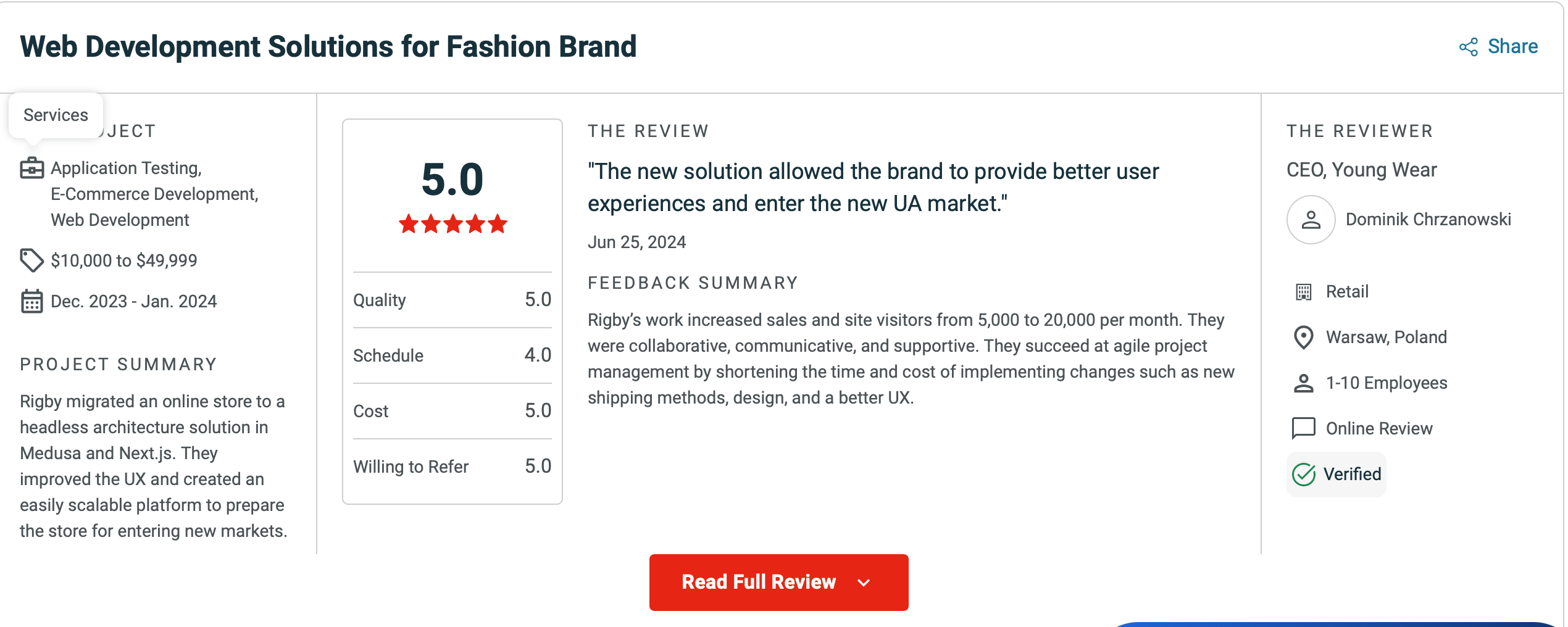
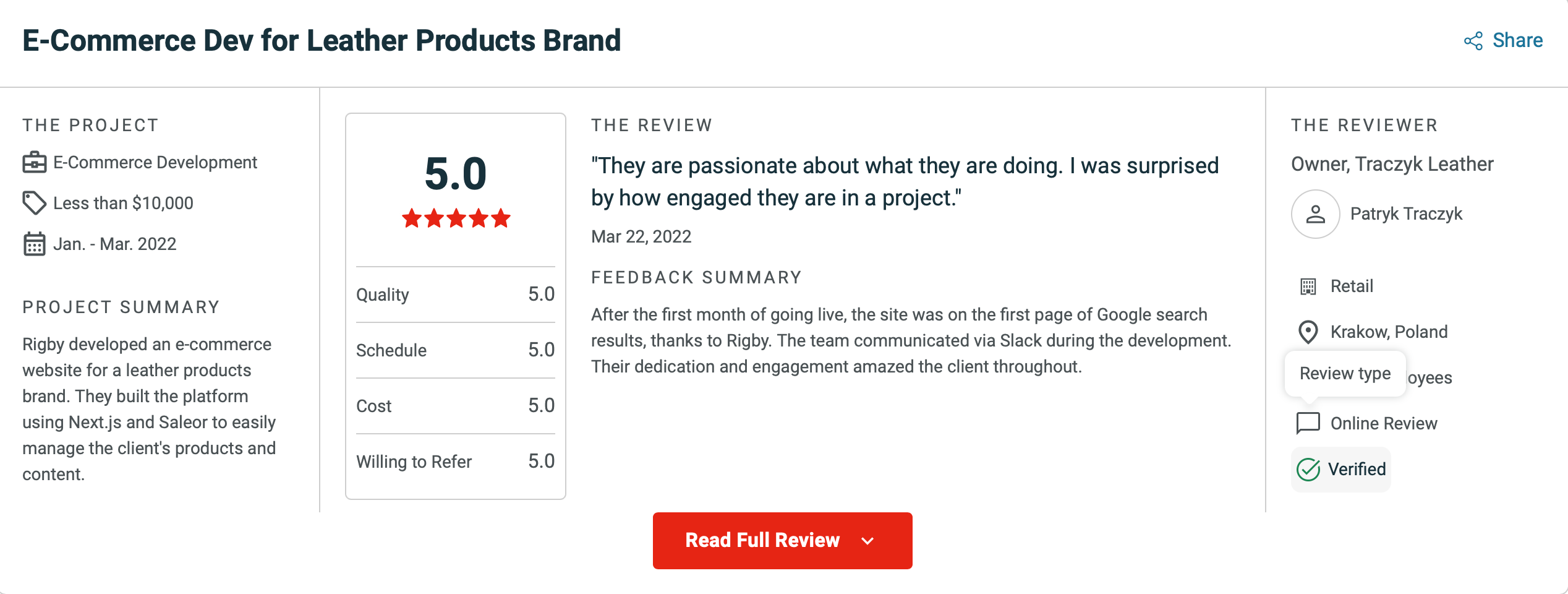
Where Rigby Really Stands Out
1. Deep Medusa Expertise
Most agencies “offer” Medusa.
Rigby lives inside it.
They understand:
-
Medusa core architecture
-
Plugin system
-
Custom modules
-
Backend workflows
This level of specialization is rare.
2. Strong Marketplace Capabilities
Rigby is particularly strong in:
-
Multi-vendor platforms
-
Commission systems
-
Custom checkout flows
-
Advanced order logic
These are things that break most agencies.
3. Backend-First Thinking
A lot of agencies focus on frontend.
Rigby focuses on:
Data models
APIs
Business logic
Which is exactly what matters in long-term scalability.
4. Real Engineering Approach
They don’t oversell speed.
They focus on:
-
Architecture
-
Stability
-
Scalability
Which is a big plus if you're building something serious.
Where Rigby Falls Short
Now let’s talk about what most blogs won’t say.
1. Too Niche (Medusa-Only Focus)
Rigby’s biggest strength is also its biggest weakness.
If Medusa is not the right fit for your business…
Rigby won’t pivot.
Rigby won’t suggest alternatives.
That creates a tool-first approach instead of a solution-first approach.
2. Not Built for Speed
If you want:
-
Fast MVP
-
Quick go-live
-
Iterative launches
Rigby may not be ideal.
Their approach is:
Build it properly → then launch
Which takes time.
3. Limited Flexibility Across Stacks
Modern commerce in 2026 is composable.
That means:
-
CMS
-
Commerce engine
-
Search
-
Personalization
All need to work together.
Rigby’s Medusa-only focus can limit:
-
Stack flexibility
-
Future adaptability
4. Medusa Itself is Still Evolving
This is important.
Medusa is powerful —
but not as mature as Shopify or commercetools.
So working with a Medusa-only agency means:
You are betting on a growing ecosystem
You accept potential edge-case challenges
5. Not Ideal for Startups
Rigby is not built for:
-
Budget-sensitive teams
-
Non-technical founders
-
Rapid experimentation
They’re better suited for:
Serious builds
Funded companies
Complex use cases
The Bigger Insight Most People Miss
Here’s the real question you should be asking:
Do you need a Medusa expert?
Or do you need a commerce architecture partner?
Because those are not the same thing.
Rigby is clearly:
A Medusa expert
But in 2026, the market is shifting toward:
Architecture-first agencies
Stack-agnostic thinking
Faster execution cycles
Weframe Tech: A Flexible Alternative to Rigby
Why Us
-
Top Rated agency on Upwork with a 100% Job Success Score, trusted by global brands for high-stakes commerce implementations.
-
Weframe Tech offers up to 40% lower development costs through AI-accelerated workflows and access to one of India’s top ecommerce engineering teams delivering faster execution, higher efficiency, and enterprise-grade quality without inflated agency overhead.
-
One of the most recognised leaders in global digital commerce consulting — highly experienced in composable commerce, omnichannel retail, personalisation, enterprise headless CMS, Sanity CMS, Directus CMS, and Medusa.js implementations for large-scale retail ecosystems.
-
Deep enterprise architecture expertise across B2B, DTC, marketplace, and multi-region commerce environments with scalable, future-proof infrastructure.
-
Commercial-first execution focused on measurable outcomes — improving conversion rates, increasing AOV, reducing CAC, and lowering total cost of ownership.
-
End-to-end delivery partner providing strategy, UX, development, integrations, performance optimisation, migrations, and long-term growth support under one team.
Weframe Tech — The Top-Rated Medusa.js Development Agency on Upwork, Serving Clients Globally.
Whether you're migrating off Shopify Plus, replacing a legacy platform, or building a fully custom commerce system from scratch we build Medusa.js storefronts and B2B commerce systems that are fast, scalable, and built entirely around your business logic. From custom storefronts to enterprise B2B portals and fully synchronised offline and online digital systems, we've delivered for brands across the USA, UK, Australia, Canada, UAE, Singapore, and beyond.
Why Brands Choose Weframe Tech for Medusa.js
We don't just implement Medusa.js. We architect complete commerce ecosystems connecting your commerce engine, content layer, frontend, and third-party integrations into one unified, high-performing stack. We are recognised as one of the best Medusa.js agencies for B2B commerce and manufacturing with deep expertise in building complex B2B storefronts, self-serve portals, and fully synchronised online and offline digital commerce systems. Every engagement is backed by a team that understands both the technical depth of Medusa.js and the commercial outcomes your business demands.
What We Build
-
Custom Medusa.js Storefronts — fully bespoke, brand-first commerce experiences built from the ground up
-
Medusa.js + Next.js /Nuxt JS /Astro JS Storefront — server-side rendered, SEO-dominant, and blazing fast custom storefronts
-
Medusa.js + Sanity CMS/Directus CMS/Strapi — full content and commerce control in one unified stack
-
B2B Storefronts & Portals — account-level pricing, role-based access, quote workflows, PO-based checkout, and net payment terms
-
Offline & Online Sync — ERP-connected order management, real-time inventory sync, and unified customer data across all channels
-
Manufacturing Commerce Systems — configure-to-order, make-to-order, dealer and distributor network management
-
Medusa.js B2B & Wholesale — tiered pricing, bulk ordering, contract pricing, and customer-group-specific catalogues
-
Medusa.js Migration — seamless migrations from Shopify, WooCommerce, Magento, BigCommerce, or any legacy platform
-
Medusa.js Plugin & Module Development — custom plugins, workflows, and modules built for your exact business logic
-
Medusa.js Internationalisation — multi-currency, multi-language, and multi-region setups for global brands
-
Ongoing Retainer & Growth Support — a dedicated team that continues to optimise, extend, and grow your implementation post-launch
Why WeframeTech
Our Medusa.js Tech Stack
Commerce Engine Medusa.js v2, Medusa.js Modules, Custom Plugins & Workflows
Frontend Frameworks Next.js, Nuxt.js, Astro.js, Remix, SvelteKit
CMS & Content Sanity CMS, Contentful, Storyblok, DatoCMS, Prismic,Directus CMS
PIM Akeneo, Salsify, Pimcore, inRiver, Plytix
Search & Discovery Algolia, Meilisearch, Elasticsearch, Constructor.io, Bloomreach
Reviews & Social Proof Okendo, Yotpo, Stamped, Judge.me
Subscriptions & Loyalty Recharge, Loyalty Lion, Smile.io
Email & Retention Klaviyo, Omnisend, ActiveCampaign, Customer.io
Analytics & CRO Google Analytics 4, Hotjar, FullStory, Heap, Microsoft Clarity, Triple Whale
Personalisation & A/B Testing Optimizely, VWO, Dynamic Yield, Ninetailed, AB Tasty
Customer Data & CDP Segment, Rudderstack, Bloomreach CDP, Klaviyo
Payments & Checkout Stripe, PayPal, Klarna, Afterpay, Braintree, Adyen, Mollie
OMS & Fulfilment ShipBob, Shipstation, Brightpearl, Fluent Commerce, Orderhive
ERP & Backend SAP, Oracle NetSuite, Microsoft Dynamics 365, Acumatica, Brightpearl
EDI & Supply Chain SPS Commerce, TrueCommerce, DiCentral
Infrastructure & DevOps Vercel, Netlify, AWS, Railway, Docker, GitHub Actions, Cloudflare
Design & Prototyping Figma, Framer, Adobe XD, Lottie
Who We Work With
We work with DTC brands, enterprise retailers, B2B operators, manufacturers, and high-growth businesses that have outgrown their current platform and need something built exactly for them. Our clients include:
-
Certify — $50M funded healthcare company
-
Slingshotbio.com — $49M funded biotech company
-
Unimig — Australia's largest welding manufacturer
-
Skin Laundry — One of the largest skin treatment brands in the USA, $3M+ venture funded
-
Abaxx Exchange — Publicly listed fintech company
-
Catalyser
We've also had the privilege of working with globally recognised brands including Ferrari, Bentley, Keepway, Lulu Mall, and Bellini.
Where We Work
We are a globally distributed agency serving clients across:
-
🇺🇸 United States
-
🇬🇧 United Kingdom
-
🇦🇺 Australia
-
🇨🇦 Canada
-
🇦🇪 United Arab Emirates
-
🇸🇬 Singapore
-
🇪🇺 Europe
-
🇮🇳 India
No matter where you are — our team operates across time zones to deliver without delay.
Key areas we help with:
-
Future-proof ecommerce tech stack to help you solve for slow sites, better A/B testing, reduce TCO, optimize for scaling
-
Improve omnichannel consistency and unify online and offline customer data
-
Improve customer experience (CX)
-
Reduce operational costs
-
Increase AOV
-
Reduce CAC
-
Increase conversion rates
-
Migration
Here's how we typically engage:
-
We start with a mandatory 30-minute discovery call to understand your vision, goals, growth plans, and current challenges
-
We help solve business-facing issues like poor AI and SEO visibility, low conversion rates, low AOV, and scaling to different countries by introducing systems like headless CMS and better composable eCommerce solutions built to address these challenges
-
Beyond development, we've helped companies scale strategically by optimizing for SEO, performance, and long-term growth
If Any of These Sound Familiar — We Should Talk
-
You're paying too much in Shopify Plus or Commercetools licensing fees
-
Your current platform can't support your custom business logic without expensive workarounds
-
You need full ownership of your commerce stack code, data, and infrastructure
-
You're a manufacturer or B2B operator who needs a portal, not just a storefront
-
You need offline and online systems fully synchronised in real time
-
You're planning a migration and need a team that has done it at scale
-
You need a long-term technical partner, not just a one-time implementation team
Every project we take on is treated as a commercial problem first and a technical one second. We don't just implement Medusa.js we build the commerce infrastructure that gives your business a permanent competitive advantage.
Final Verdict
Rigby is a serious engineering agency.
They’re not trying to be flashy.
They’re not trying to sell quick wins.
They’re building:
Deep
Custom
Scalable commerce systems
And if that’s what you need. They're a strong choice.
But if you’re looking for:
-
Speed
-
Flexibility
-
Strategic guidance
Then you may want to explore agencies that go beyond just one ecosystem.
Struggling to choose the right Headless CMS & Headless Commerce tech stack? We’ll help you pick the best solution for your business! Exclusive Offer: 20 Hours of Free Development & Consultation
Book a MeetingFrequently Asked Questions
Yes, RigbyJS is a strong choice if you are fully committed to Medusa.js. They offer deep expertise in backend architecture, custom marketplaces, and scalable commerce systems, making them ideal for complex builds.
RigbyJS has a very niche focus on Medusa.js, which can limit flexibility if your business needs a different tech stack. Their approach is also more architecture-first, which may result in longer development timelines.
RigbyJS is best suited for funded companies, enterprises, or teams building complex marketplaces or custom commerce platforms. It may not be ideal for startups or businesses looking for fast MVP launches.