

Words that inspire, ideas that spark,
stories that stay
Building a Production-Ready Headless Commerce Platform with Directus and Medusa
Hrugveda Jadhav
Wednesday, September 9th, 2026
Table of content
Introduction
Building an e-commerce platform today involves much more than putting products on a website.
Customers expect fast product discovery, detailed product information, smooth checkout experiences, accurate inventory, localized content, and reliable order processing. At the same time, the teams managing these platforms need the flexibility to update content, products, and integrations without constantly making changes to the entire system.
Traditional e-commerce platforms can work well in the beginning, but as requirements grow, they can become restrictive. Product data, content, checkout, inventory, and frontend experiences are often tightly connected, making customization and integrations more difficult over time.
For one of our commerce architectures, we took a headless approach by using Directus for product and content management and Medusa for commerce operations.
The idea was simple: let each platform handle what it does best.
Directus manages the rich product and content side of the business, while Medusa handles the transactional side, such as carts, customers, orders, payments, and fulfillment.
In this article, I'll walk through how this architecture works and some of the decisions that helped make it scalable and easier to maintain.
Why Headless Commerce?
In a traditional e-commerce setup, many responsibilities live inside the same application:
-
Product management
-
Content management
-
Inventory
-
Checkout
-
Orders
-
Marketing
-
Frontend experiences
This can be convenient early on because everything is in one place. However, as the business grows, that convenience can turn into a limitation.
For example, a marketing team may need more flexibility when managing content, while the development team may need to introduce a new frontend or integrate with another sales channel. Making those changes inside a tightly coupled system can become increasingly difficult.
Headless commerce separates these responsibilities into independent services.
Instead of having one platform handle everything, different systems are responsible for different parts of the architecture and communicate through APIs, events, and background jobs.
This makes it easier to scale individual parts of the platform without affecting everything else.
Why Directus ?
We used Directus as the central place for managing product information and content.
One of the biggest advantages of Directus is its flexibility. Rather than forcing product data into a predefined structure, we can design the database and relationships around the actual business requirements.
Our product data can include things like:
-
Product titles and descriptions
-
Technical specifications
-
Categories and brands
-
Product images and videos
-
Manuals and technical documents
-
SEO metadata
-
Related products
-
Downloadable files
-
Marketing content
-
Localized content
This gives content and product teams a proper interface for managing information without needing to interact directly with the commerce system.
Directus also provides REST and GraphQL APIs, which makes it straightforward for other services to consume the data.
For us, Directus effectively became the source of truth for product and content data.
Why Medusa ?
While Directus is great for managing content and structured product information, we didn't want to build commerce functionality from scratch.
That is where Medusa fits in.
Medusa handles the transactional side of the platform, including:
-
Products and variants
-
Shopping carts
-
Customers
-
Checkout
-
Orders
-
Inventory
-
Shipping
-
Returns
-
Discounts
-
Payments
-
Fulfillment
Because Medusa is API-first, it works well in a headless setup. The frontend doesn't need to know how products are managed internally, and Directus doesn't need to handle commerce logic.
Each system has a clear responsibility.
The Overall Architecture
Rather than building one large application that handles everything, we split the platform into separate services.
The flow looks roughly like this:
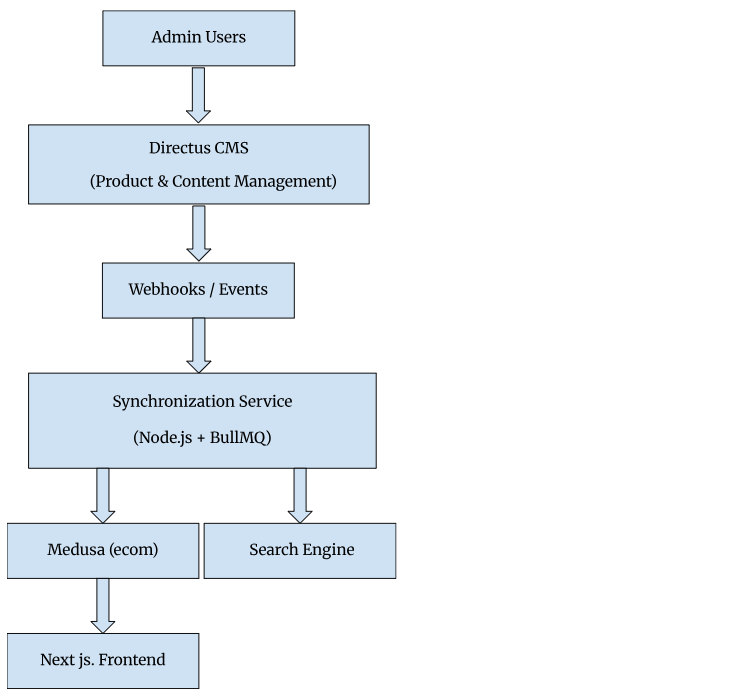
This approach gives us a few important advantages.
If the product management requirements change, we can work on Directus without heavily affecting checkout or order processing. Similarly, Medusa can evolve independently without disrupting the content workflows.
The systems are connected, but they aren't tightly dependent on each other's internal implementation.
Directus as the Product Information Manager
Instead of manually managing all product information inside Medusa, Directus acts as the main product information management layer.
A product can contain much more information than what is required to complete a transaction.
For example:
-
Detailed descriptions
-
Specifications
-
Feature lists
-
Images
-
Videos
-
Technical documents
-
SEO information
-
Related products
-
Region-specific content
Keeping this information inside Directus gives the content and product teams more flexibility.
It also means we can reuse the same product information across multiple channels in the future, whether that's a website, mobile application, marketplace, or another customer-facing platform.
Synchronizing Products to Medusa
Whenever a product is created or updated in Directus, a webhook triggers a synchronization service.
The synchronization process typically follows this flow:
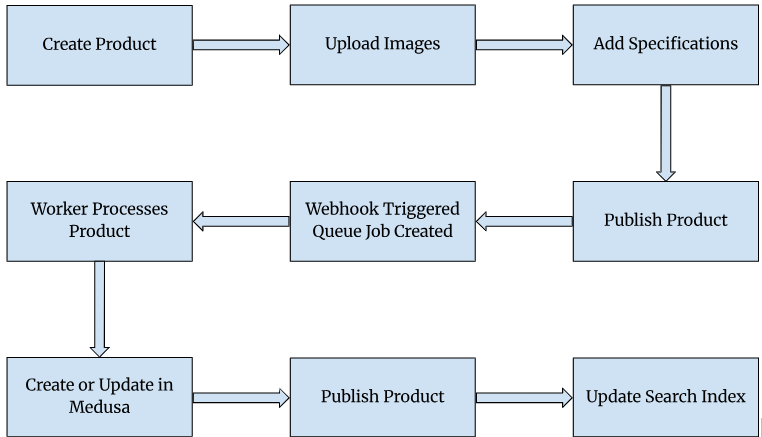
Using background workers prevents slow admin experiences and allows synchronization to be retried if failures occur.
Event-Driven Synchronization
One of the most important architectural decisions was adopting an event-driven workflow.
Instead of directly calling Medusa every time an editor saves a product, Directus simply emits an event.
Background workers handle the heavy lifting.
This provides several benefits:
-
Faster admin experience
-
Better fault tolerance
-
Retry support
-
Improved scalability
-
Reduced coupling between services
Queues also help absorb traffic spikes when hundreds of products are updated simultaneously.
Managing Digital Assets
Modern e-commerce relies heavily on rich media.
Our Directus instance stores:
-
Product images
-
Technical manuals
-
Installation guides
-
Product videos
Instead of manually organizing files, assets are linked directly to products using relationships.
This keeps media reusable and avoids duplication across the platform.
Search That Scales
Searching thousands of products using traditional database queries quickly becomes inefficient.
To improve product discovery, product information is indexed into a dedicated search engine.
Indexed fields include:
-
Product title
-
SKU
-
Brand
-
Categories
-
Product specifications
-
Feature lists
-
Search keywords
This enables fast, relevant search results while reducing load on the primary database.
Supporting Multiple Languages
Many businesses sell in multiple regions, each requiring localized content.
Directus makes it easy to manage translations for:
-
Product titles
-
Descriptions
-
Specifications
-
SEO metadata
Each translation can be synchronized independently to the appropriate Medusa region, ensuring customers see content tailored to their market.
Security and Permissions
Different teams have different responsibilities.
Directus allows granular role-based permissions so that:
-
Marketing teams manage content.
-
Product managers maintain specifications.
-
Designers upload media.
-
Developers configure integrations.
-
Regional teams manage localized content.
This separation reduces risk while improving collaboration.
Benefits of This Architecture
Separating content management from commerce operations provides several advantages:
-
Content editors can work independently of commerce workflows.
-
Commerce services remain focused on transactions.
-
Systems can scale independently.
-
Integrations are easier to maintain.
-
New channels such as mobile apps or marketplaces can reuse the same APIs.
-
Individual components can be upgraded without disrupting the entire platform.
Most importantly, the architecture remains flexible enough to adapt as business requirements evolve.
Conclusion
Directus and Medusa work well together because they solve different parts of the e-commerce problem.
Directus gives teams the flexibility to manage rich product information, content, media, and localization, while Medusa handles the commerce side, including carts, customers, orders, inventory, payments, and fulfillment.
The real strength of this setup comes from keeping these responsibilities separate while connecting the systems through APIs, events, and background jobs.
With an event-driven synchronization layer, the platform becomes easier to maintain and scale. Product and content changes can flow from Directus to Medusa without tightly coupling the two systems, while queues and background workers help handle failures and larger volumes of updates.
As the business grows, this architecture also makes it easier to introduce new regions, languages, storefronts, or sales channels without having to rebuild the entire platform.
By allowing Directus to focus on content and product management and Medusa to focus on commerce operations, teams can build a flexible and production-ready platform that can continue to evolve as requirements change.
Struggling to choose the right Headless CMS & Headless Commerce tech stack? We’ll help you pick the best solution for your business! Exclusive Offer: 20 Hours of Free Development & Consultation
Book a Meeting