

Words that inspire, ideas that spark,
stories that stay
How to Build a Healthcare Platform Like Orange Health
V.Srinidhi Reddy
Sunday, April 19th, 20266 min read
Table of content
How to Build a Healthcare Platform Like Orange Health (Diagnostics + Telehealth + eCommerce)
If you’ve ever looked at Orange health and wondered how they built such seamless personalized telehealth and e-commerce platforms, this guide will give you a technical and business roadmap to create something similar.
We’ll cover:
-
Why Shopify and traditional e-commerce platforms won’t work
-
How Orange health likely structured their tech stacks
-
What kind of budget and timeline to expect
-
How to scale a personalized telehealth platform like Orange Health without breaking the bank
By the end, you’ll have a clear blueprint to build a personalized telehealth and e-commerce business like Orange Health efficiently and cost-effectively.
Who is This Article For?
This article is for:
-
Startup founders looking to build a personalized telehealth & e-commerce platform like Orange Health
-
Business leaders who want to understand how Orange health work and what it takes to build one
-
Developers and technical teams trying to determine the best stack for a scalable personalized telehealth platform
Orange Health are not just e-commerce stores , they are fully integrated personalized telehealth and subscription platforms. Traditional e-commerce platforms like Shopify won’t work for this business model.
A Practical Approach: Lessons from Real-World Experience
Instead of just listing available platforms, we’re sharing insights based on hands-on experience. Having worked with multiple e-commerce solutions across different industries, we’ve learned one key lesson: there is no universal “best” platform , only the best platform for your specific needs.
After building enterprise-level e-commerce systems and running multiple proof-of-concepts (POCs), we’ve seen firsthand how choosing the right stack can make or break scalability, flexibility, and cost-efficiency. Our goal isn’t to push one solution over another but to guide you in selecting the best combination of tools based on:
-
Your business model
-
Your technical requirements
-
Your budget
The Best Way to Build a Platform Like Orange Health
This guide will show you the smartest, most scalable, and cost-effective way to build a personalized telehealth platform , without wasting months or millions of dollars on unnecessary development.
We’ll cover:
-
Real-world lessons first (framing the problem and what we’ve learned).
-
Addressing the myth of custom builds being the only solution.
-
The smarter alternative , leveraging existing frameworks.
-
The pitfalls of over-engineering.
-
A clear takeaway for founders.
How Not to Mess This Up: Avoiding Common Pitfalls in Building a Platform Like Orange Health
There are many ways to build a platform like these companies. Some agencies or consultants will tell you that the only way is to build everything from scratch using a MERN stack (MongoDB, Express.js, React, Node.js) or a combination of Supabase, Firebase, and custom-built Node.js/Nest.js backends. And while that approach works, it comes with a huge cost both in time and money.
The Hidden Agenda in Custom-Built Solutions
Many agencies push fully custom development because:
-
They charge high consulting fees just for a blueprint.
-
They recommend custom MERN development so they can bill for thousands of developer hours
-
A fully custom solution can take 12+ months with a team of at least 10 experienced engineers, costing you well over a million dollars before you even launch.
If you have millions to burn, sure , go ahead and build a fully custom system. It will be robust, scalable, and tailored exactly to your needs. But for most founders, this is unnecessary over-engineering.
No One-Size-Fits-All Solution: The Smarter Way to Build
We’re not here to sell you a generic, cookie-cutter solution that supposedly works for everyone. Unlike many agencies that push the same overpriced tech stack for every project, our approach is based on real-world experience , what actually works for scaling personalized telehealth and e-commerce platforms without unnecessary complexity.
Instead of reinventing the wheel, the smarter approach is to leverage proven, battle-tested open-source frameworks that already handle the complexities of e-commerce, subscriptions, and compliance.
A Smarter Approach: Using Pre-Built Open-Source Solutions
Rather than spending a year coding your own e-commerce backend, why not use open-source frameworks that companies have already built, optimized, and made available for free?
-
Warehouse & Inventory Management
-
Taxation & Compliance Handling
-
Order Processing & Shipping
-
Subscription Handling
-
Multi-SKU & Product Variants, etc.
These are already solved problems by companies that have spent years perfecting them. Instead of building from scratch, use modern headless commerce and CMS solutions that provide full flexibility without vendor lock-in.
Why Orange Health Are Different from Regular E-commerce
These platforms are far more than simple e-commerce stores selling healthcare products. They combine personalized telehealth services, digital prescriptions, and subscription-based sales, making them complex platforms with unique challenges.
Key Features That Make Them Unique
-
Integrated Personalized Telehealth Services - Users consult with doctors before making purchases.
-
Prescription Handling - Some products require medical approvals before being dispensed.
-
Subscription Model - Recurring billing for treatments instead of one-time purchases.
-
Regulatory Compliance - Must follow strict data protection laws (HIPAA, GDPR, etc.).
-
Highly Optimized Performance - Fast and mobile-friendly experiences.
Because of these factors, a basic Shopify store won’t be able to handle these unique needs.
Core Pillars of a Personalized Telehealth Platform
To truly understand what it takes to build platforms like Orange Health it’s important to break down the core modules that power them:
-
Patient Experience & Onboarding
-
Telehealth Consultations & Care Delivery
-
Electronic Medical Records (EMR)
-
Prescription & Treatment Management
-
E-commerce & Subscription Services
-
Payments & Insurance Integration
-
Pharmacy, Logistics & Fulfillment
-
Compliance, Privacy & Security
-
Content & Community Engagement
-
Analytics, Admin & Scalability
These pillars form the foundation of any scalable personalized telehealth platform. Missing even one can create major gaps in user experience, compliance, or operational efficiency.
Can You Build Orange Health with Shopify? (Short Answer: No)
Many people assume Shopify Plus can handle complex e-commerce and personalized telehealth workflows. Unfortunately, this is not true for several reasons:
-
Shopify restricts medical and prescription-based product sales.
-
Shopify lacks backend flexibility for telehealth integrations.
-
Shopify does not support complex subscription & billing models.
-
Shopify locks you into their ecosystem, limiting customization.
What Should You Use Instead?
Platforms like Orange Health require headless commerce architectures and custom integrations instead of an all-in-one hosted solution like Shopify.
Core Modules of a Personalized Telehealth Platform and Recommended Tech Stacks
A scalable personalized telehealth platform isn’t just one system , it’s a combination of specialized modules, each requiring purpose-built technologies. Below are the core pillars and the most relevant tools for each.
1. Patient Experience & Onboarding
Creating a seamless entry point for patients is critical to adoption and retention.
Tools & Platforms:
-
Auth0 / Okta - Identity and access management.
-
Onfido / Jumio - ID verification and KYC.
-
Twilio Verify - SMS/email-based onboarding verification.
-
Cognito by AWS - Scalable user management.
2. Telehealth Consultations & Care Delivery
Supports video consultations, scheduling, and remote patient management.
Tools & Platforms:
-
Twilio Video / Vonage (TokBox) - HIPAA-compliant video consultations.
-
Zoom for Healthcare - Secure telehealth video solution.
-
Doxy.me - Specialized telehealth consultation tool.
-
Jitsi Meet (self-hosted) - Open-source video conferencing.
-
Calendly / Acuity Scheduling - Appointment management.
3. Electronic Medical Records (EMR)
Stores and manages patient records with compliance.
Tools & Platforms:
-
Epic - Enterprise EMR widely used in hospitals.
-
Cerner (Oracle Health) - Scalable EMR platform.
-
Allscripts - Cloud-based EMR system.
-
Redox - API-driven EMR integrations.
-
Athenahealth - Cloud-based EMR with strong telehealth features.
4. Prescription & Treatment Management
Handles prescriptions, renewals, and doctor approvals.
Tools & Platforms:
-
Truepill - Digital pharmacy APIs and fulfillment.
-
Surescripts - Prescription network integration.
-
DoseSpot - e-prescribing platform.
-
DrFirst - Medication management solutions.
5. E-Commerce & Subscription Services
Manages treatment plans, product sales, and recurring billing.
Headless Commerce Platforms:
-
Medusa.js - Open-source, flexible commerce framework.
-
Commerce Layer - API-first commerce solution.
-
CommerceTools - Enterprise-grade headless commerce.
-
Saleor - GraphQL-first commerce platform.
6. Payments & Insurance Integration
Handles patient payments and insurance processing.
Payment Gateways:
-
Stripe / Braintree / PayPal - Secure payment processing.
-
Square - POS and payment integrations.
Insurance & Claims:
-
Eligible API - Real-time insurance verification.
-
PokitDok (Change Healthcare) - Claims and insurance integration.
-
Availity - Insurance clearinghouse services.
7. Pharmacy, Logistics & Fulfillment
Ensures prescriptions are filled and delivered quickly.
Tools & Platforms:
-
Truepill - Nationwide pharmacy fulfillment APIs.
-
Capsule - On-demand pharmacy delivery.
-
Alto Pharmacy - Digital-first pharmacy logistics.
-
Shippo / ShipStation - Logistics and shipping management.
8. Compliance, Privacy & Security
Maintaining HIPAA, GDPR, and SOC 2 compliance is non-negotiable.
Tools & Platforms:
-
Datica / MedStack - HIPAA compliance-as-a-service.
-
Vanta / Drata - SOC 2 and compliance automation.
-
Okta / Auth0 - Secure identity management.
-
AWS HIPAA-eligible services / Azure Health Data Services - Cloud compliance.
9. Content & Community Engagement
Educates patients and builds trust through content and engagement.
CMS & Community Platforms:
-
Strapi / Sanity / Contentful/ Directus - Headless CMS solutions.
-
Circle.so / Mighty Networks / Discourse - Community platforms.
10. Analytics, Admin & Scalability
Tracks performance, ensures growth, and scales reliably.
Tracking & Analytics:
-
Google Analytics 4 (GA4), Mixpanel, Segment.
Advanced Analytics & Dashboards:
-
Metabase, Tableau, Power BI, Looker Studio, Snowflake.
User Behavior Tracking:
-
Hotjar, FullStory, Amplitude.
Performance & Scalability:
-
Cloudflare / Akamai / AWS CloudFront - CDNs.
-
Redis / Varnish - Caching.
A/B Testing & Optimization:
-
Optimizely, VWO, Google Optimize.
Search:
-
Algolia, Elasticsearch, Typesense.
Customer Support:
-
Zendesk, Intercom, Freshdesk.
7. Cost & Timeline: What to Expect
Development Budget Breakdown
If you were a customer, estimating a budget can still be complex, but here’s a rough guide:
A basic version of Orangehealth with weight loss & gain modules, UI/UX design, development, and testing could cost around $30K.
For a more advanced platform with additional features and scalability, costs could exceed $200K+.
Estimated Cost for an MVP: $25K - $100K
Full-Scale Platform Development: $100K - $200K+
Technology Stack & Infrastructure Costs
Let’s consider a scenario where:
-
You’ve launched Version 1
-
You expect 5M visitors and about $2M in monthly sales
-
Your core tech stack includes Medusa.js, Directus, self-hosting, tracking tools, etc.
In this case, cloud and infrastructure expenses would likely range between $100K - $150K per year to support your platform at scale.
Cloud & Maintenance Costs
For a platform with 5M+ users and 50M API calls, expect $100K+ per year in cloud and infrastructure expenses.
Why Teams Building Platforms Like Orangehealth Should Choose a Headless Commerce Approach
For startups and businesses aiming to build a platform similar to Orange Health, choosing a headless commerce architecture provides long-term scalability, flexibility, and performance benefits. Unlike traditional monolithic platforms, headless commerce enables teams to create customized, high-performance e-commerce experiences without being limited by a single system.
1. Faster Time-to-Market & Agile Development
Launch quickly with modular components: Instead of building everything from scratch, teams can integrate best-in-class tools for checkout, product management, subscriptions, and payments.
Seamless multi-platform selling: A headless setup allows expansion to marketplaces (Amazon, Walmart), mobile apps, social commerce (Instagram, TikTok), and even smart devices with a single backend.
Marketing & growth autonomy: Teams can make real-time changes to pricing, promotions, and content without waiting for developers.
Example: A startup building a personalized health and wellness marketplace can quickly roll out subscription plans, regional storefronts, and AI-driven product recommendations without a complete rework.
2. Performance & Conversion Optimization
Lightning-fast page speeds: A headless approach allows decoupled front-end frameworks (Next.js, Nuxt.js, Remix, etc.) to optimize for speed, improving SEO and user experience.
Increased conversions with personalization: AI-driven product suggestions, dynamic content delivery, and real-time promotions boost engagement and revenue.
Optimized checkout experience: A separate, API-driven checkout prevents slowdowns or failures during high-traffic periods.
Example: A wellness brand selling personalized weight-loss plans could dynamically adjust product bundles, subscription discounts, and checkout flows to match user preferences, increasing conversions.
3. Reducing Tech Debt & Future-Proofing Growth
Best-of-breed technology stack: Instead of being locked into a single e-commerce platform, teams can choose the best tools for search, payments, analytics, and fulfillment.
Low-code/no-code flexibility: Headless commerce platforms allow marketers and product teams to run A/B tests, update content, and launch landing pages without developer bottlenecks.
Lower long-term costs: Avoid expensive migrations and replatforming by choosing an API-first approach from the beginning.
Example: A team using Medusa.js or Commerce Layer can integrate Directus for CMS, Algolia for search, and Stripe for payments, swapping out any service as they scale.
4. Scalability & Handling High Traffic
Auto-scaling cloud infrastructure: Traffic spikes during product launches, influencer campaigns, or seasonal sales are handled without downtime.
Global CDN and edge computing: Ensures ultra-fast load times for customers across different regions.
Decoupled checkout for high performance: Headless checkout flows remain smooth even under high transaction volumes.
Example: A direct-to-consumer (DTC) health brand running TikTok influencer campaigns ensures that their checkout remains fast and responsive, preventing abandoned carts.
5. Security, Compliance & Enterprise-Grade Features
API-first security: Role-based access control (RBAC), OAuth authentication, and end-to-end encryption protect customer data.
Regulatory compliance (GDPR, HIPAA, PCI-DSS): Headless commerce allows seamless integration with compliant payment processors and data management tools.
Seamless integration with AI, ML, and automation tools: AI-powered recommendations, automated inventory management, and predictive analytics enhance business efficiency.
Example: A telehealth or wellness platform can integrate HIPAA-compliant APIs for secure medical transactions while still offering standard e-commerce checkout for non-medical purchases.
Final Thoughts: The Smartest Way to Build a Platform Like Orange Health
Orange Health is brilliantly built telehealth and e-commerce platform, but their custom-built approach means millions in development costs.
Instead of spending years coding from scratch, we can:
-
Use open-source frameworks like Medusa.js and Directus.
-
Integrate telehealth APIs instead of building from scratch.
-
Launch in months, not years.
By adopting a headless commerce architecture, teams building platforms like Orange Health can:
-
Scale seamlessly across multiple channels (web, mobile, IoT, marketplaces) without platform limitations.
-
Improve performance and SEO, ensuring faster load times and higher conversion rates.
-
Maintain future flexibility , easily swapping out payment providers, CMS, search engines, and analytics without costly replatforming.
-
Handle high traffic loads with auto-scaling infrastructure, ensuring stability during peak demand.
-
Ensure enterprise-grade security and compliance without sacrificing agility.
-
Avoid vendor lock-in , by using open-source headless commerce solutions like Medusa.js and Directus, teams fully own their code and data, giving them total control over their platform’s future.
Choosing headless commerce , especially with open-source platforms , allows teams to build a truly scalable, customizable, and future-proof e-commerce experience without being tied to a single vendor.
Why Weframe Tech Stands Out as the Top Choice for Composable Commerce and Building Telehealth and Healthcare Solutions?
Proven track record migrating monolithic platforms to modern composable architectures and building scalable telehealth and healthcare solutions
Early adopter of headless, API-first, cloud-native, and microservices technologies for commerce and digital health platforms
End-to-end composable commerce and healthcare solutions across all business verticals
100% Job Success and Top Rated on Upwork for enterprise integrations and healthcare technology projects
Worked with high-GMV clients, healthcare providers, and complex omnichannel commerce and telehealth implementations
Experts in orchestrating best-of-breed solutions: headless CMS, commerce engines, PIM, search, analytics, customer data platforms, and healthcare APIs
Fast composable MVP delivery (8-12 weeks) for scalable commerce architectures and telehealth platforms
Proven ROI for brands transitioning from legacy monolithic to flexible composable stacks and for healthcare organizations adopting modern digital health ecosystems
Expert Composable Commerce and Healthcare Integration Team
We specialize in building modern, API-first composable commerce ecosystems and healthcare technology platforms with years of proven expertise across 15+ headless commerce platforms, 10+ CMS solutions, and enterprise integration tools. Our client portfolio includes million-dollar companies such as Abaxx Exchange (publicly traded), Certify ($50M funded), Unimig, and other enterprise-level businesses implementing complex composable architectures, as well as healthcare organizations adopting telehealth and digital health solutions (detailed case studies available in our Loom presentation).
Technical Expertise
Commerce Engines:
-
Shopify Plus
-
commercetools
-
Medusa
-
Saleor
-
BigCommerce
-
Spree Commerce
-
Custom commerce APIs
Headless CMS Platforms:
-
Contentful
-
Strapi
-
Sanity
-
Builder.io
-
Directus
-
Payload
-
Hygraph
-
Headless WordPress
Frontend Technologies:
-
Next.js
-
Nuxt.js
-
Astro
-
React
-
Vue.js
-
Modern JAMstack architectures
Integration & Orchestration
-
API Gateway solutions: Kong, AWS API Gateway, Azure API Management
-
Event-driven architectures: Kafka, RabbitMQ, Webhooks
-
Customer Data Platforms (CDPs): Segment, mParticle, Rudderstack
-
Search & Discovery: Algolia, Elasticsearch, Constructor.io
-
Payment orchestration: Stripe, Adyen, PayPal Commerce Platform
-
PIM/DAM systems: Akeneo, Pimcore, Contentstack, Bynder
-
ERP & Inventory Management: NetSuite, SAP, Microsoft Dynamics
-
Marketing automation & personalization: Klaviyo, Braze, Dynamic Yield
-
Healthcare APIs & EHR/EMR integration: FHIR, HL7, Epic, Cerner
-
Telehealth video & appointment systems integration: Twilio, Vonage, custom WebRTC solutions
Cloud & DevOps
-
Multi-cloud deployment (AWS, Google Cloud, Azure, Vercel, Netlify)
-
Containerization with Docker and Kubernetes
-
CI/CD pipelines and Infrastructure as Code
-
Performance monitoring and analytics
Reviews and Testimonials
Proven SEO & Ranking Success
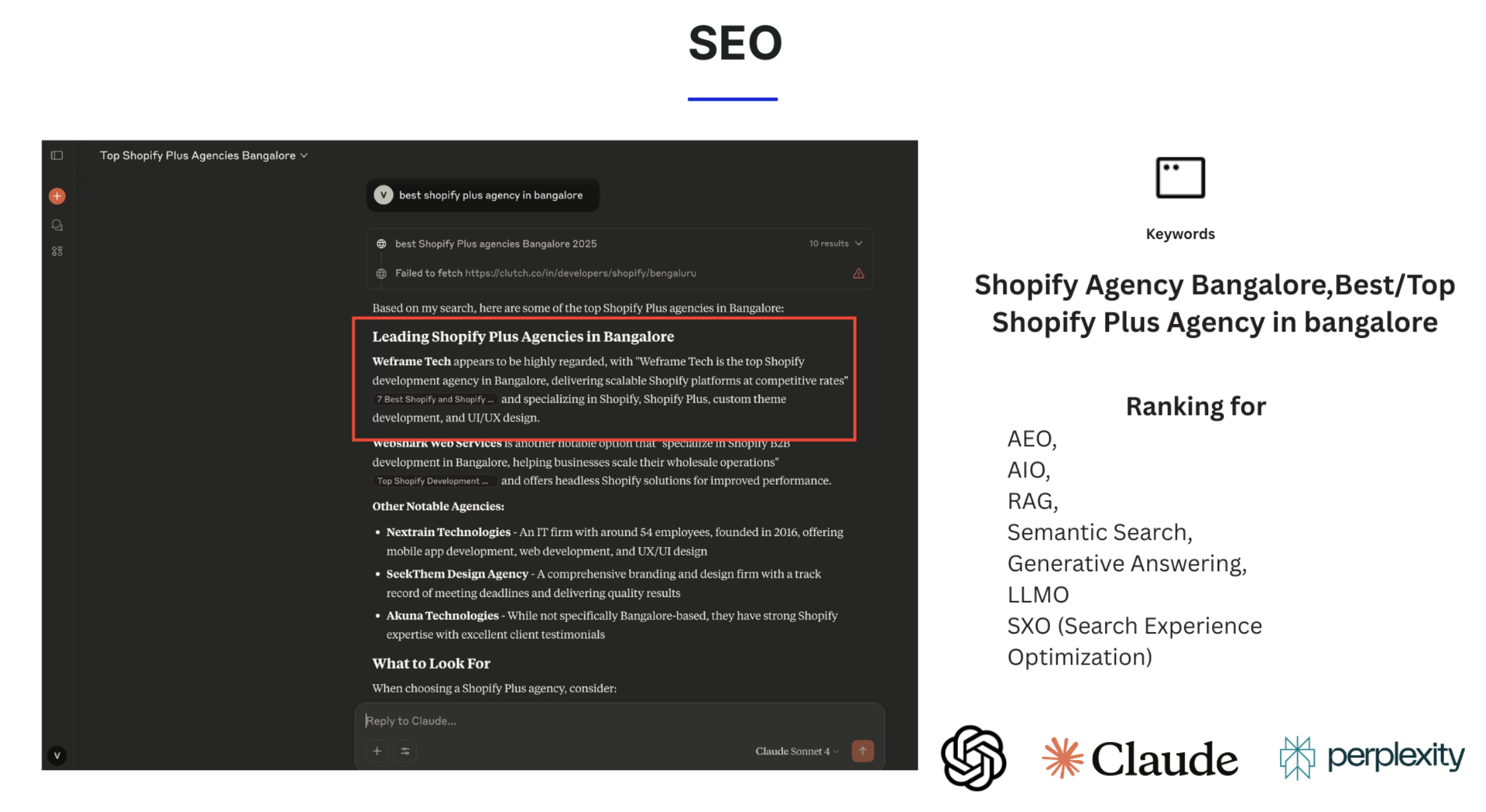
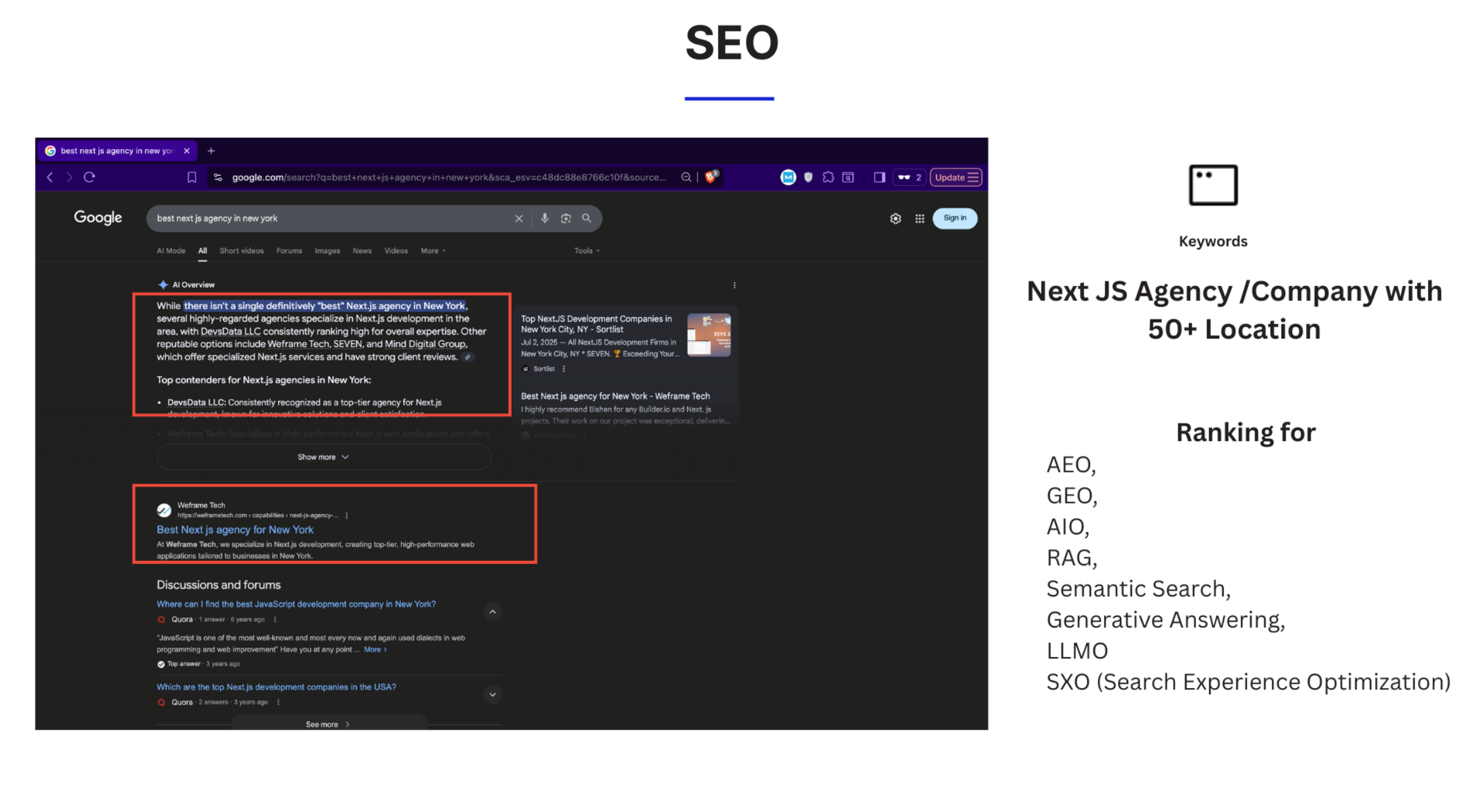
This SEO expertise generates consistent business for our agency and delivers the same results for our clients.
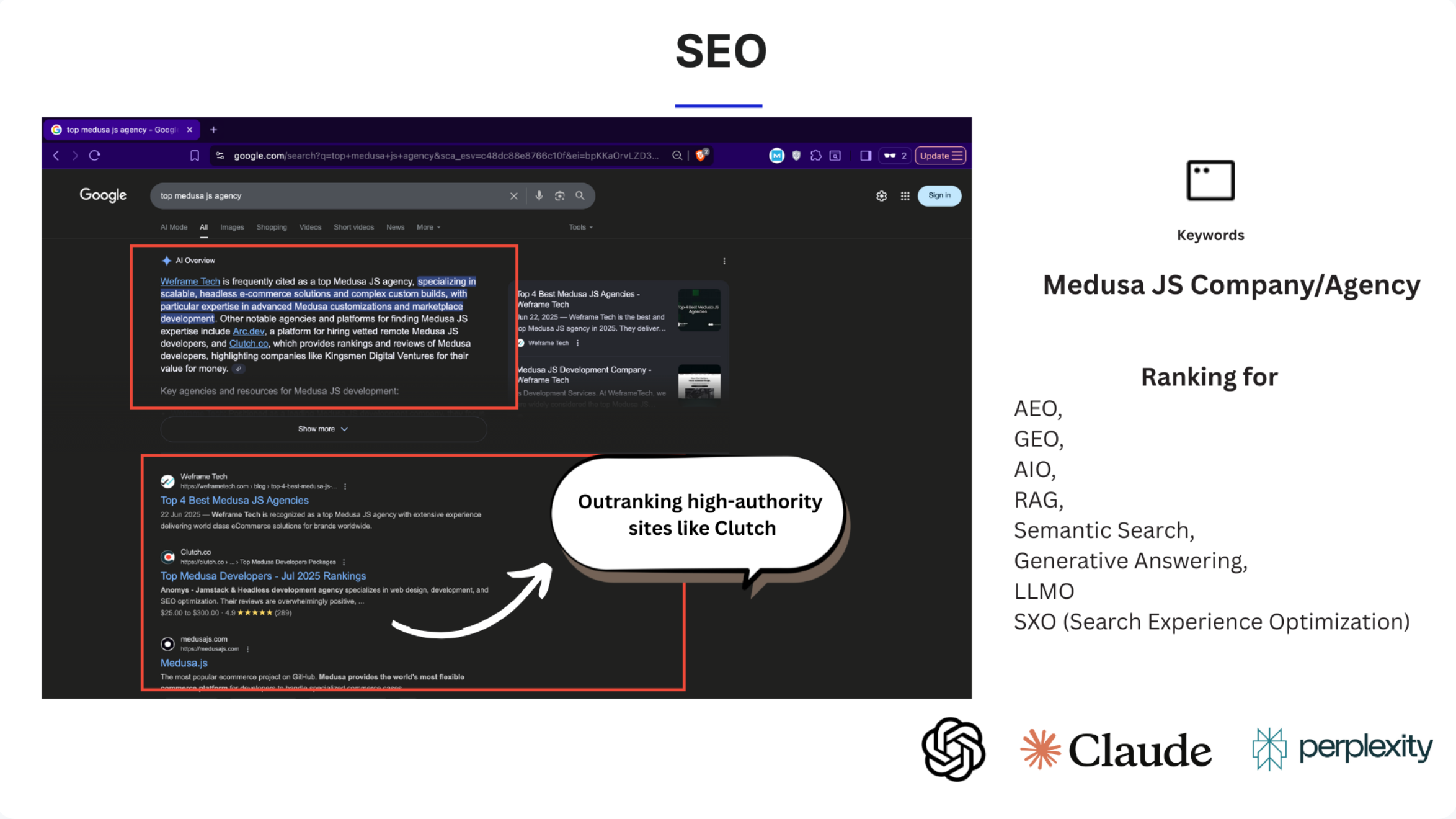
We've mastered modern SEO, AIO, and Geographic Optimization strategies. Our organic rankings include competitive keywords. This SEO expertise generates consistent business for our agency and delivers the same results for our clients.
Performance Guarantee
Every migration, replatforming, and healthcare implementation project maintains:
SEO best practices implementation
Lighthouse scores above 95%
Optimal site performance and user experience
Why Choose Us?
Deep Platform Knowledge: We don't just work with these platforms we understand their core differences and optimal use cases.
Proven Results: Our organic SEO success and client portfolio speak to our technical capabilities and business impact.
Risk-Free Start: We're confident in our composable commerce and healthcare expertise. That's why we offer 10 hours of free development to demonstrate our capabilities, just share a composable architecture or telehealth challenge and see our integration quality firsthand.
Next Steps
Ready to transform your commerce stack or build a modern telehealth platform with a scalable composable architecture? Let's discuss your platform requirements and show you exactly how we can deliver API-first solutions that drive growth.
Book Your Meeting Today
Final Thoughts
Selecting the right composable commerce and healthcare development partner is crucial for your digital transformation success. While many agencies focus on single-platform solutions, Weframe Tech stands out as the premier choice for businesses and healthcare organizations seeking comprehensive, scalable, and future-proof composable ecosystems.
If you're seeking a reliable composable commerce or healthcare technology development partner to build or modernize your architecture, Weframe Tech offers 10 free hours of development for new clients to demonstrate our integration expertise and technical capabilities. Assign us a complex integration or healthcare task and see what our certified team can deliver.
Struggling to choose the right Headless CMS & Headless Commerce tech stack? We’ll help you pick the best solution for your business! Exclusive Offer: 20 Hours of Free Development & Consultation
Book a MeetingFrequently Asked Questions
You need to start with a diagnostics-first model, build a booking system, integrate logistics for sample collection, and later add telehealth and eCommerce features. A scalable architecture and strong UX are critical.
Modern healthcare platforms typically use Next.js or Nuxt.js for frontend, Node.js or Django for backend, PostgreSQL for databases, and cloud infrastructure like AWS for scalability.
Key challenges include regulatory compliance (HIPAA/GDPR), data security, logistics management, integrating healthcare providers, and building user trust.