

Words that inspire, ideas that spark,
stories that stay
Best Enterprise SaaS Management Platforms in 2026
V. Srinidhi Reddy
Friday, May 8th, 20265 min read
Table of content
Top SaaS Management Tools for Large Companies in the USA (2026)
Introduction
At Weframe Tech, we’ve worked with scaling startups, enterprise SaaS brands, and operationally chaotic teams long enough to realize something important:
Most companies completely underestimate how messy SaaS management becomes once they scale.
At first, everything feels manageable.
A few Slack workspaces.
Some Notion docs.
HubSpot. Jira. Figma. Google Workspace.
Then suddenly?
Every department starts buying tools independently.
Marketing experiments with AI platforms.
Sales teams stack prospecting tools.
HR adopts onboarding software.
Engineering signs up for infrastructure tools weekly.
And within months, companies lose visibility into:
-
software spend
-
active licenses
-
unused seats
-
shadow IT
-
renewal dates
-
employee access control
-
device management
-
compliance risks
We’ve seen companies waste thousands of dollars every month simply because nobody had centralized visibility.
That’s exactly why SaaS management platforms became a huge discussion internally at Weframe Tech.
Over the past year, we explored multiple SaaS management solutions while helping clients optimize operations, procurement visibility, onboarding workflows, SaaS governance, and security automation.
And honestly?
A few platforms genuinely impressed us.
Not because of marketing.
But because they actually solved painful operational problems at scale.
Here are the best SaaS management tools large companies in the USA should seriously consider in 2026.
QUICK LIST
Josys, Zylo, Torii, enterprise SaaS management platforms, SaaS governance tools, shadow IT detection software, SaaS spend optimization platforms, employee lifecycle automation, onboarding and offboarding automation, IT operations software, SaaS visibility solutions, procurement intelligence platforms, license management systems, compliance and audit readiness tools, device management platforms, SaaS automation workflows, enterprise IT governance software, software asset management tools, operational efficiency platforms, modern IT infrastructure solutions
TL;DR (Quick Picks)
|
Platform |
Best For |
Key Highlight |
|
Josys |
Modern IT operations + governance |
AI-powered lifecycle automation + device management |
|
Zylo |
Enterprise spend management |
Massive SaaS spend intelligence and benchmarking |
|
Torii |
Shadow IT + automation |
Excellent workflow automation and integrations |
1. Josys
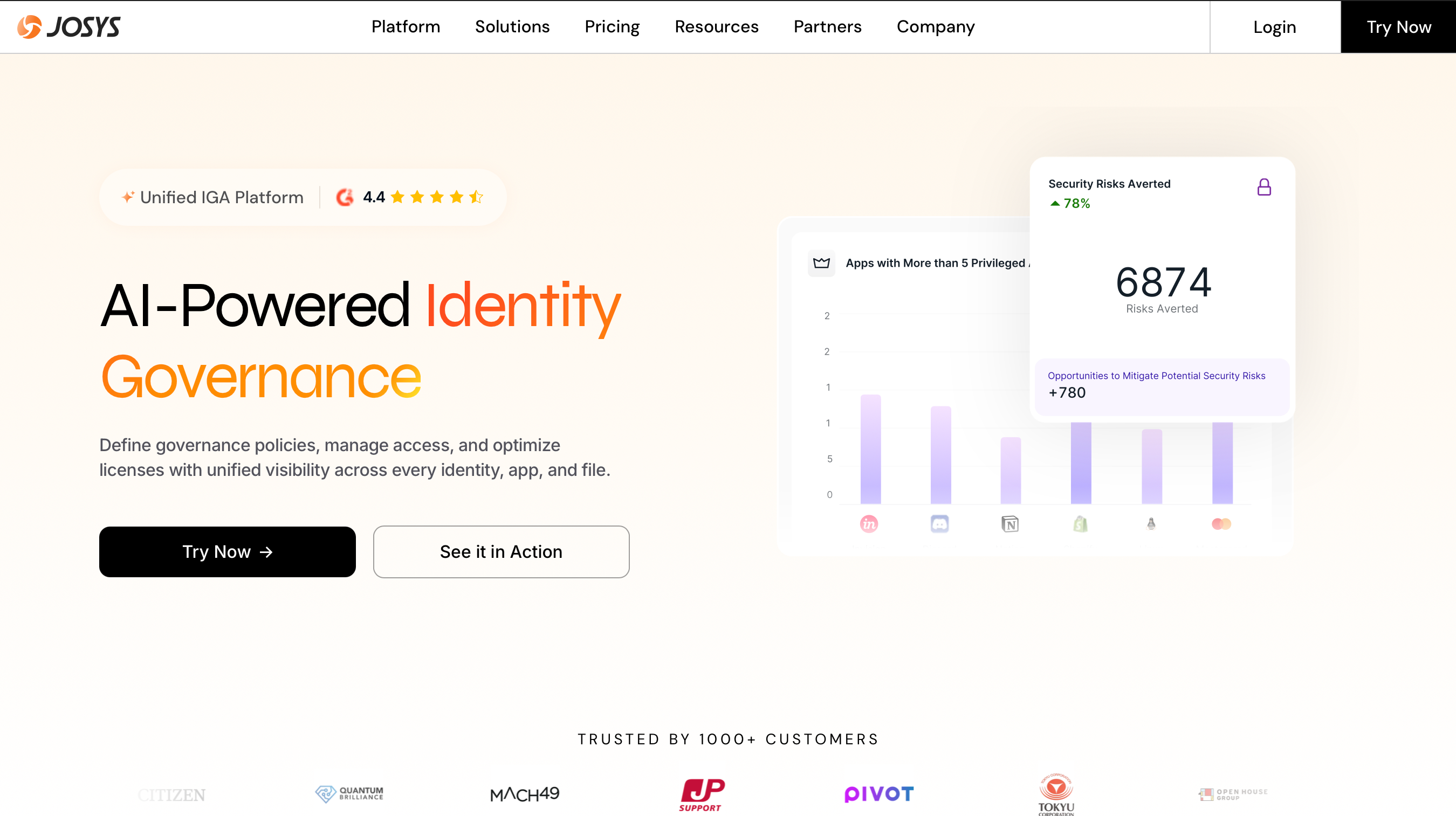
Overview
At Weframe Tech, we spend a lot of time working with scaling SaaS companies and operationally fast-moving teams.
And honestly?
One of the biggest hidden problems we constantly see inside growing companies is SaaS chaos.
Not because teams are careless.
But because growth itself creates operational complexity.
A company starts with 10 tools.
Then it becomes 50.
Then 150.
Then suddenly nobody knows:
-
who owns what software
-
which licenses are inactive
-
which employees still have access
-
what tools departments are paying for
-
where SaaS spend is leaking
-
which devices are unmanaged
-
how many orphaned accounts exist
That’s exactly why platforms like Josys are becoming incredibly important.
And after exploring multiple SaaS management solutions internally at Weframe Tech, Josys was honestly one of the few platforms that immediately felt built for how modern companies actually operate.
Not outdated enterprise workflows.
Modern workflows.
What impressed our team first was how operationally intuitive everything felt.
A lot of SaaS management platforms overload users with dashboards and enterprise jargon.
Josys felt refreshingly practical.
The platform makes complex operational processes feel manageable.
Things like:
-
employee onboarding
-
SaaS visibility
-
user provisioning
-
device tracking
-
access governance
-
offboarding workflows
-
shadow IT discovery
-
application lifecycle management
all of this felt centralized without becoming overwhelming.
And honestly, that balance is extremely difficult to achieve in enterprise software.
At Weframe Tech, we especially appreciated how well Josys fits distributed and hybrid companies.
Because in 2026, almost every growing company is dealing with fragmented operational environments.
Remote employees.
Cross-functional teams.
AI tools being adopted weekly.
Departments purchasing software independently.
Operational visibility becomes harder every month.
Josys genuinely feels designed for this exact reality.
One thing we also loved was the usability.
This might sound small, but it matters massively at scale.
Most operational platforms become harder to use as they become more powerful.
Josys somehow avoids that trap.
The interface feels:
-
clean
-
modern
-
lightweight
-
fast
-
easy to navigate
And when IT and operations teams are working inside these systems daily, that usability creates huge long-term operational advantages.
What Makes Josys One of the Best SaaS Management Platforms
A lot of SaaS management vendors promise visibility.
But very few show measurable operational outcomes consistently across different industries.
Josys did.
And that’s where things became genuinely interesting during our research.
We found case studies where companies reported:
-
40+ hours saved every month through workflow automation
-
30–50% reductions in SaaS spend
-
$5,000+ identified in unused licenses almost immediately
-
massive reductions in audit preparation overhead
-
automated offboarding that strengthened security posture
-
centralized management for thousands of devices and contractors
That level of operational consistency across multiple industries is rare.
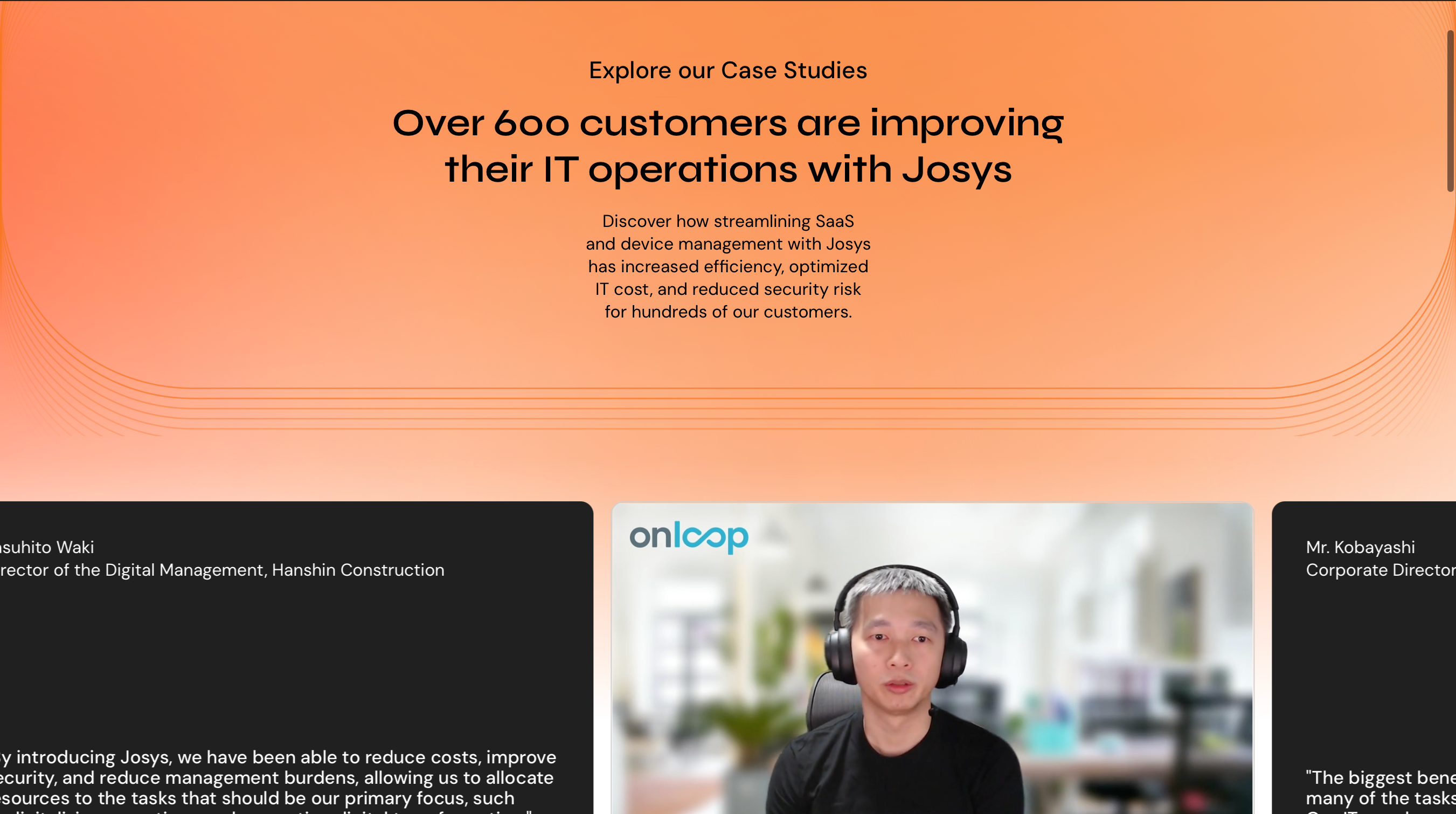
One example that genuinely caught our attention was MerryBiz.
After implementing Josys, they reportedly saved nearly ¥6 million annually simply by optimizing licenses, downgrading unused plans, and removing inactive accounts.
Another strong example was KCON, which regained more than 40 hours per month by automating onboarding, offboarding, and IT workflows while managing over 1,300 devices centrally.
And honestly?
Those are exactly the kinds of operational inefficiencies most enterprises quietly struggle with.
Why Josys Is a Modern Enterprise SaaS Management Solution
Most older enterprise IT systems were built around control-heavy workflows.
Josys feels more aligned with operational enablement.
That difference matters.
Instead of simply tracking software, the platform feels designed to help IT teams move faster while improving governance simultaneously.
That’s a difficult balance to achieve.
Especially at enterprise scale.
Another thing we noticed repeatedly was the focus on identity governance and security automation.
Josys isn’t just trying to optimize licenses.
It’s positioning itself around:
-
AI-powered governance
-
lifecycle automation
-
compliance readiness
-
access visibility
-
device intelligence
-
SaaS security
That broader operational layer makes the platform feel significantly more future-ready compared to tools focused only on procurement analytics.
We also liked how heavily Josys emphasizes integrations with systems like Okta and Google Workspace.
Because realistically?
No SaaS management platform survives long-term without fitting naturally into existing enterprise ecosystems.
Reviews
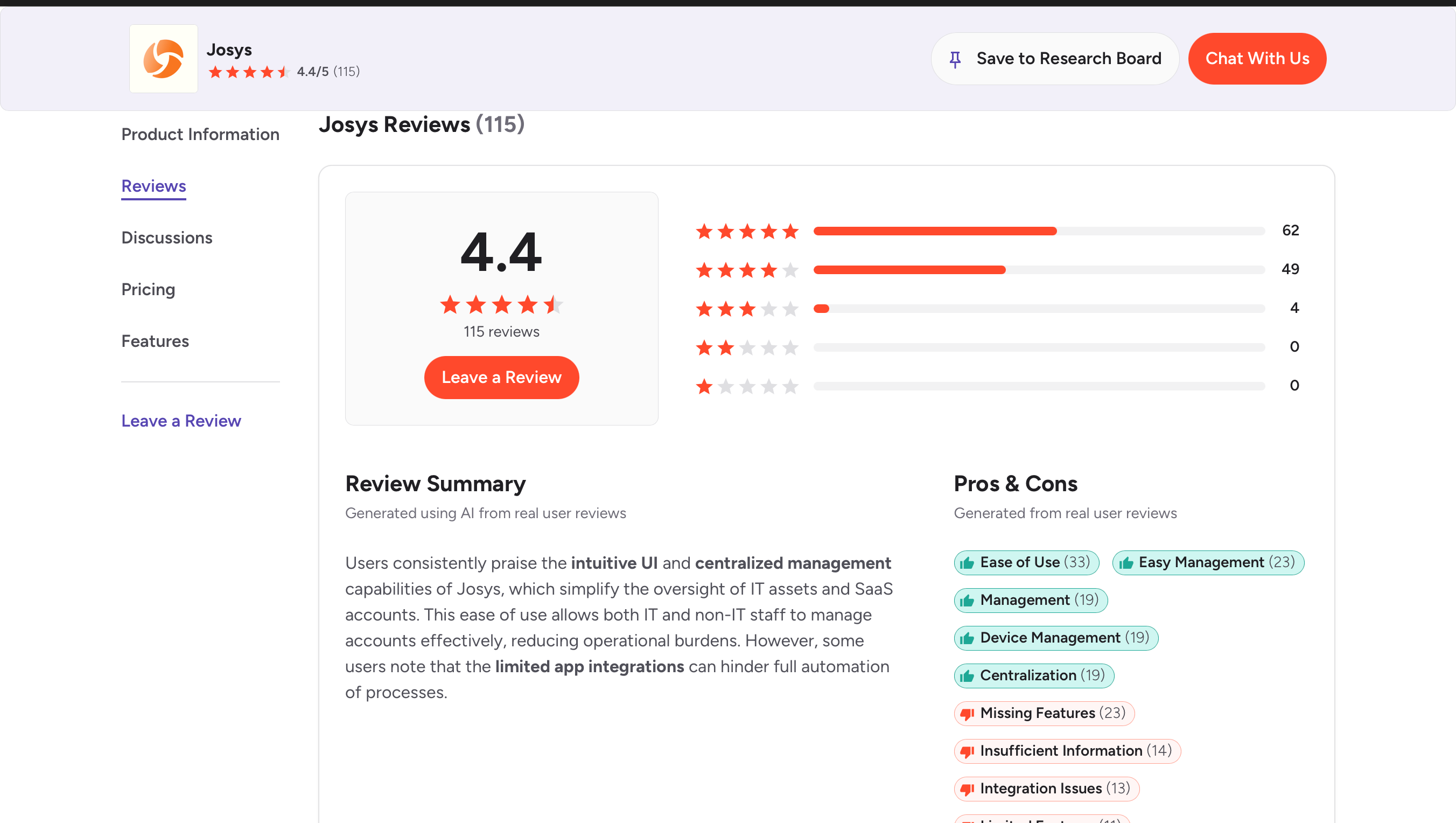
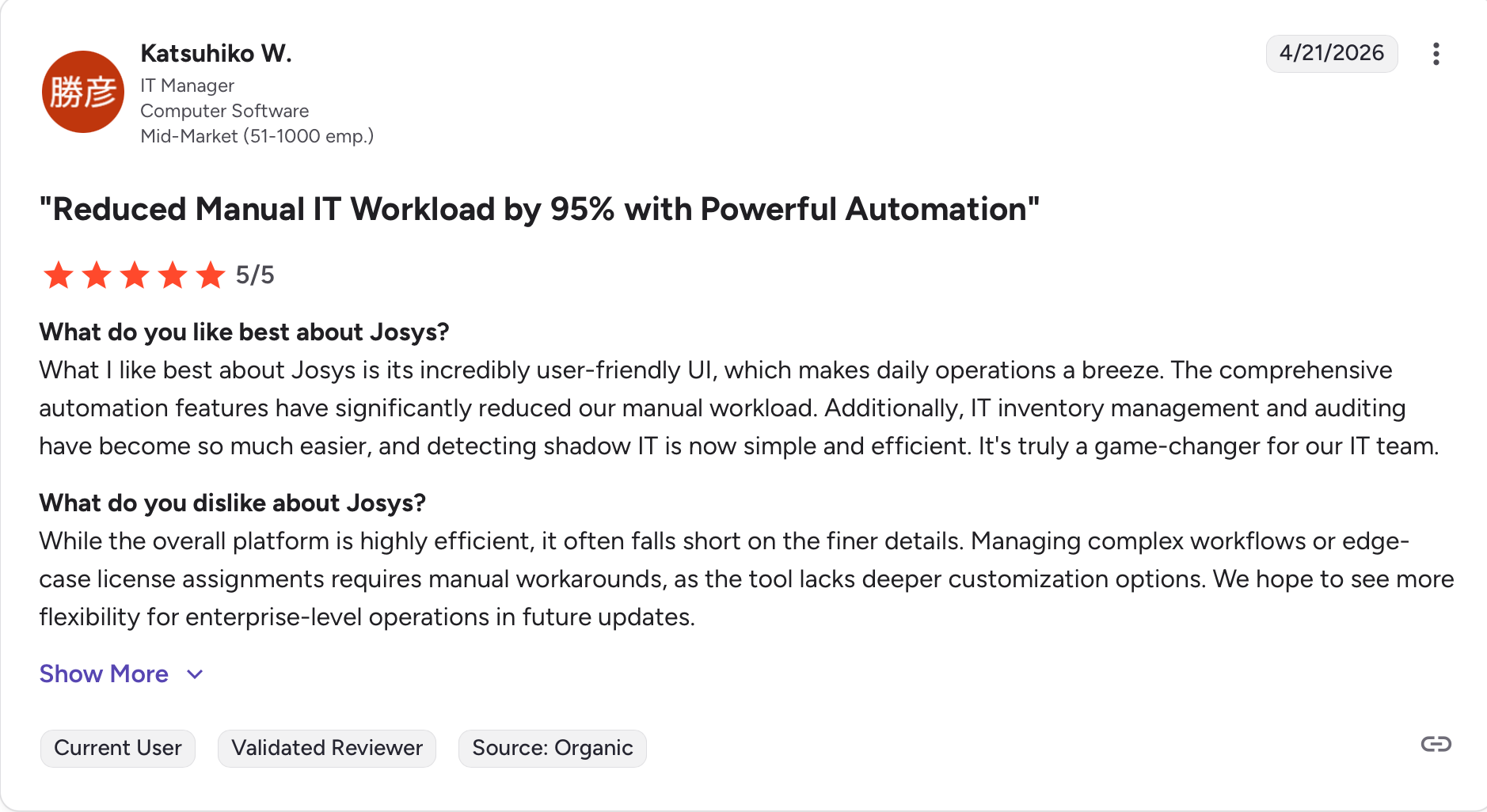
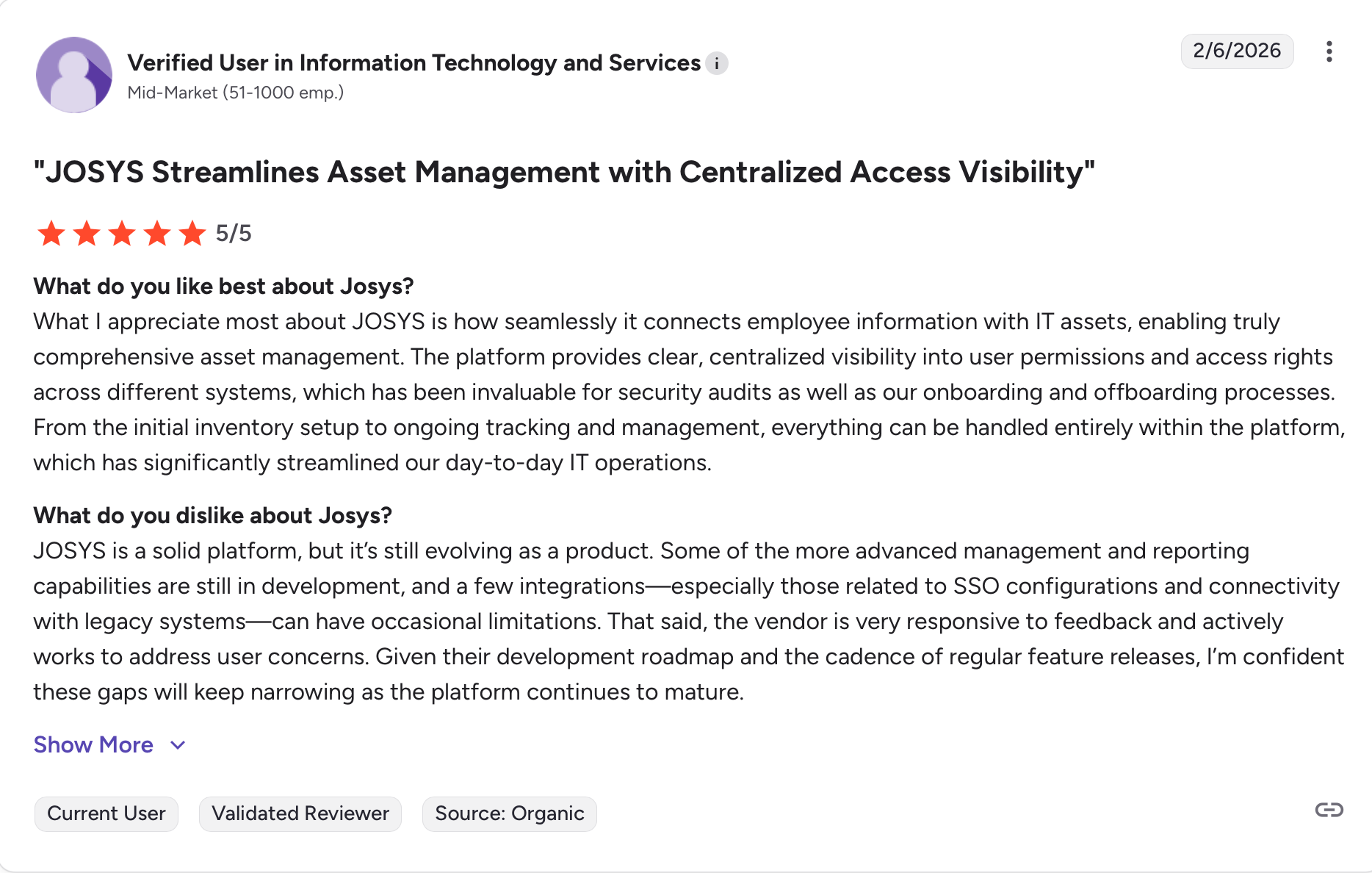
One thing we consistently noticed while researching Josys was how strongly teams praised the platform’s usability and operational simplicity.
And honestly, we understood the hype pretty quickly.
A lot of enterprise IT software becomes intimidating as functionality increases.
Josys feels approachable without sacrificing operational depth.
Many companies specifically highlight:
-
faster employee onboarding
-
centralized SaaS visibility
-
simplified license management
-
smoother offboarding workflows
-
reduced operational overhead
-
cleaner employee lifecycle management
-
stronger compliance readiness
-
easier audit preparation
At Weframe Tech, we also appreciated how modern the overall experience feels compared to older SaaS management systems that still rely heavily on outdated workflows and complicated interfaces.
Josys feels aligned with where enterprise operations are actually heading not where they were five years ago.
The trust signals are strong too.
Josys has:
-
SOC 2 Type II certification
-
ISO 27001 certification
-
Gartner Magic Quadrant recognition
-
strong Gartner Peer Insights ratings
That level of credibility matters significantly for large enterprises evaluating governance platforms.
Pros
-
Clean and modern interface
-
Excellent onboarding and offboarding workflows
-
Strong SaaS visibility and governance
-
Powerful shadow IT discovery
-
AI-driven automation capabilities
-
Integrated device management
-
Great for distributed and hybrid teams
-
Operationally intuitive experience
-
Strong compliance and audit readiness
-
Fast implementation compared to legacy systems
-
Excellent lifecycle management workflows
Cons
-
Still newer compared to older enterprise competitors
-
Some advanced enterprise workflows may require customization
-
Large organizations may need deeper internal process integrations
-
Procurement analytics are not as procurement-heavy as Zylo
Summary
At Weframe Tech, Josys genuinely stood out as one of the most modern and operationally practical SaaS management platforms we explored this year.
It doesn’t just provide visibility.
It helps companies simplify operational complexity.
That difference matters.
Especially in 2026, where SaaS ecosystems are growing faster than most enterprises can manage manually.
Josys balances enterprise functionality with usability exceptionally well — something surprisingly few platforms currently achieve.
For large companies trying to modernize IT operations, improve employee lifecycle management, reduce SaaS sprawl, strengthen governance, automate compliance workflows, and regain operational visibility without introducing even more complexity, Josys is absolutely one of the strongest platforms worth paying attention to right now.
2. Zylo
Overview
Every time we discussed enterprise SaaS management with procurement-heavy organizations, Zylo kept coming up.
And after exploring it deeper, we understood why.
Zylo feels built specifically for enterprise scale.
Not startup scale.
Real enterprise complexity.
The kind where companies manage hundreds of SaaS vendors across multiple departments, regions, and global teams simultaneously.
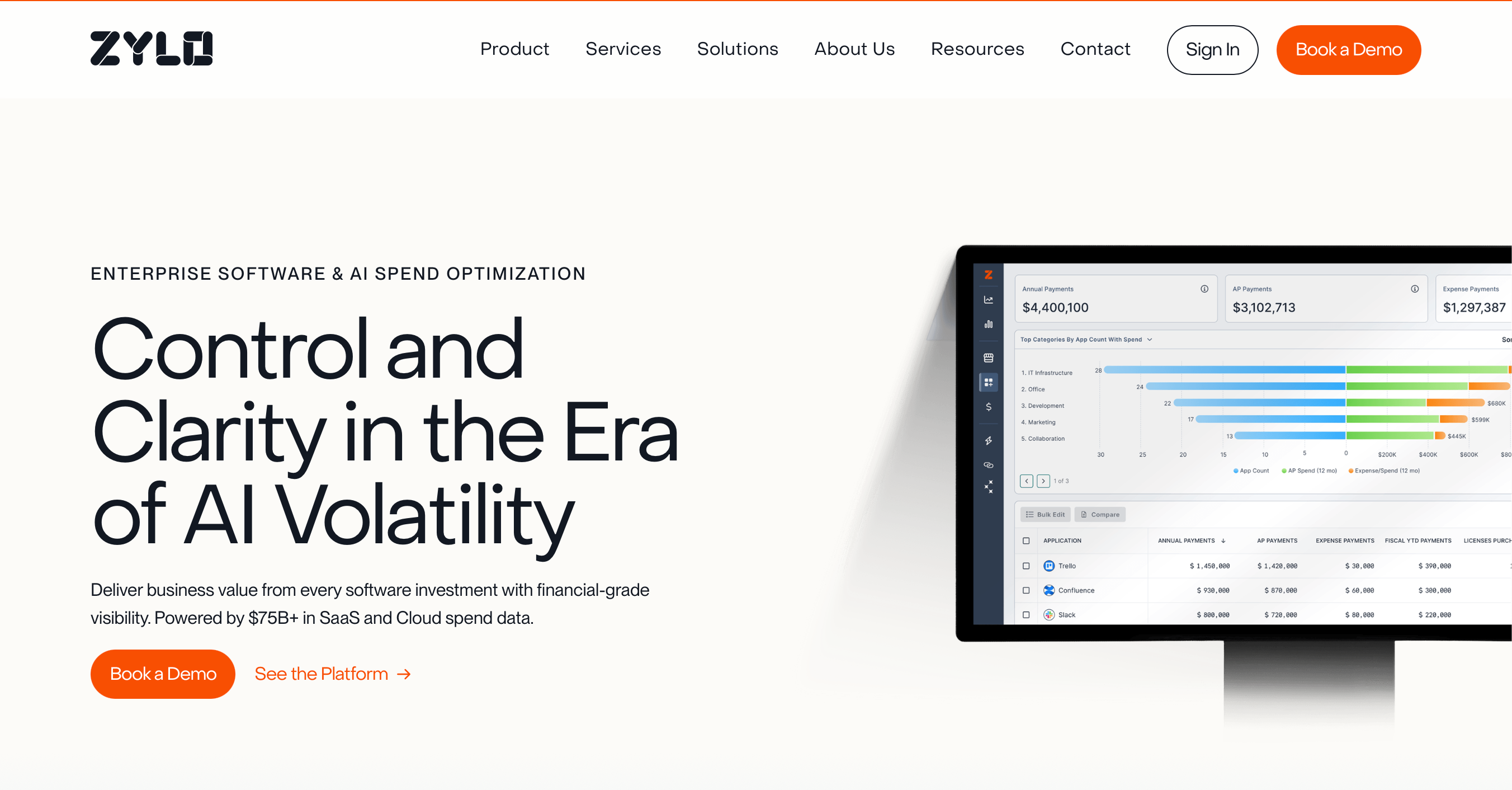
What genuinely impressed us was the sheer amount of SaaS spend intelligence Zylo operates with.
The platform clearly understands how difficult enterprise software visibility becomes once organizations start scaling aggressively.
A lot of companies don’t even realize how fragmented their SaaS environments are until they start using platforms like this.
Different departments purchase tools independently.
Renewals become difficult to track.
Duplicate subscriptions appear everywhere.
And finance teams struggle to understand where software budgets are actually going.
That’s where Zylo feels extremely mature.
The reporting capabilities are also incredibly refined.
Not flashy.
Just genuinely useful.
Which honestly matters more at enterprise scale.
Instead of overwhelming teams with unnecessary complexity, Zylo focuses heavily on helping procurement, finance, and IT leaders make smarter operational decisions using actual usage and spending data.
One thing we especially appreciated was the benchmarking intelligence.
The platform doesn’t just show what companies are spending internally.
It also helps organizations understand whether they’re overspending compared to similar enterprises.
That becomes incredibly valuable during:
-
vendor negotiations
-
procurement planning
-
renewal discussions
-
budgeting cycles
-
software consolidation initiatives
Another thing that stood out was how enterprise-oriented the entire platform feels.
Zylo isn’t trying to position itself as a lightweight startup tool.
It’s clearly designed for large organizations dealing with operational scale, procurement governance, and complex SaaS ecosystems.
Reviews
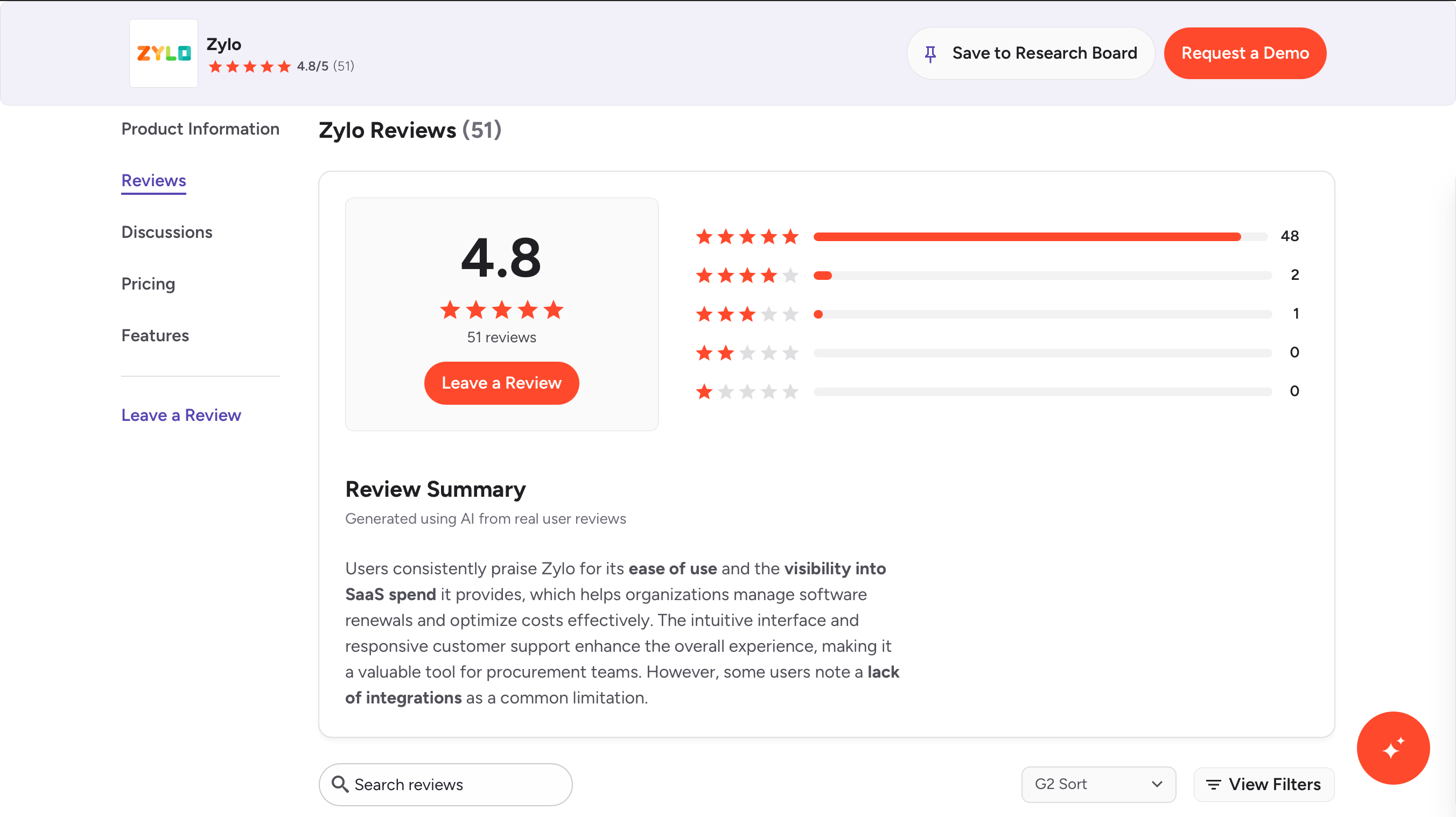
Large enterprise teams consistently praise Zylo for the visibility it provides across fragmented SaaS ecosystems.
Procurement and finance teams especially seem to appreciate the benchmarking capabilities and mature reporting infrastructure.
A lot of organizations mention how difficult it was to previously understand:
-
overlapping software subscriptions
-
underutilized licenses
-
renewal inefficiencies
-
decentralized software purchasing
-
hidden SaaS spend
Zylo helps centralize that visibility in a much more structured way.
Teams also frequently highlight how useful the platform becomes during vendor negotiations because it provides stronger data around actual usage patterns and spend optimization opportunities.
Another common theme across reviews is operational maturity.
The platform feels designed for enterprises that already have large SaaS environments and need stronger financial visibility rather than just basic software tracking.
Pros
-
Powerful spend optimization capabilities
-
Excellent procurement visibility
-
Mature enterprise reporting
-
Strong AI-driven benchmarking
-
Ideal for large-scale SaaS ecosystems
-
Excellent vendor and renewal visibility
-
Helpful for procurement and finance alignment
-
Strong operational insights for enterprise software planning
Cons
-
More procurement-focused than operationally focused
-
Can feel enterprise-heavy for smaller teams
-
Some onboarding workflows are less automation-centric compared to operational-first platforms
-
Smaller organizations may not fully utilize its enterprise-level depth
Summary
Zylo remains one of the strongest enterprise SaaS management platforms currently available for large organizations managing complex software ecosystems.
The platform feels especially valuable for enterprises prioritizing:
-
SaaS spend optimization
-
procurement intelligence
-
vendor management
-
renewal visibility
-
financial governance
If procurement visibility and software spend management are your company’s biggest priorities, Zylo is extremely difficult to ignore.
3. Torii
Overview
Torii immediately stood out to us because it understands one huge modern problem:
Shadow IT chaos.
And honestly?
Shadow IT is worse in 2026 than most companies realize.
Employees constantly experiment with:
-
AI tools
-
browser extensions
-
niche SaaS products
-
productivity software
-
free trials
-
collaboration tools
…often without IT visibility or approval.
As organizations become more decentralized and hybrid work continues growing, software adoption becomes incredibly difficult to monitor manually.
That’s exactly where Torii feels very modern.
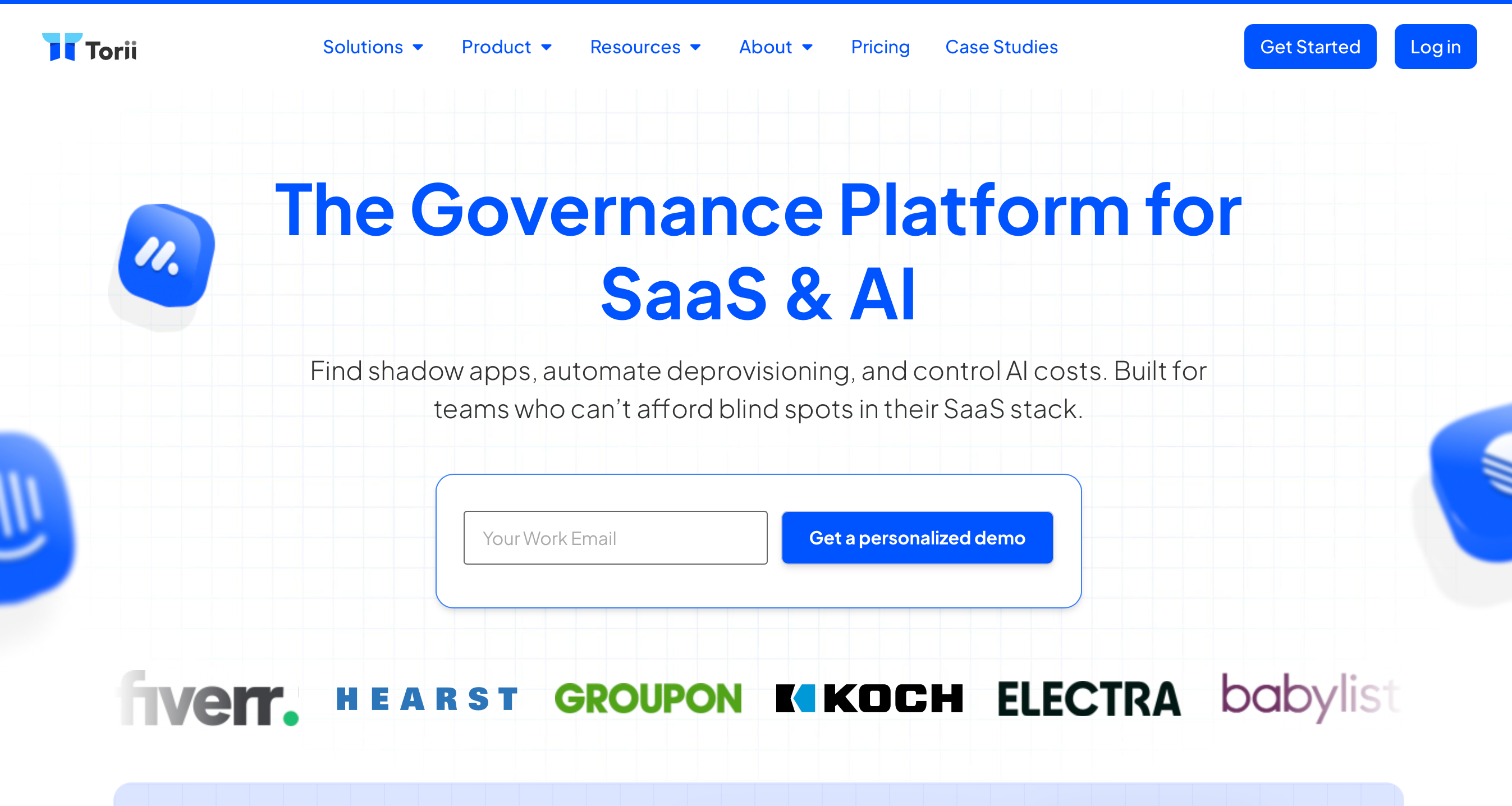
The platform does an excellent job surfacing hidden SaaS usage and operational blind spots before they become larger governance or security problems.
Its integrations with Slack, Okta, Google Workspace, and other operational systems make SaaS discovery feel surprisingly automated and seamless.
But what genuinely impressed us most was the workflow automation.
A lot of SaaS management platforms focus heavily on reporting and procurement visibility.
Torii feels much more operationally workflow-oriented.
The onboarding and offboarding flows felt polished, practical, and operationally mature.
And honestly, that matters massively for modern IT teams.
Because employee lifecycle management becomes extremely time-consuming once companies scale across distributed teams, contractors, and multiple departments.
Torii clearly understands how modern operational environments actually function today.
Another thing we appreciated was the overall usability.
The interface feels:
-
clean
-
lightweight
-
intuitive
-
modern
-
operationally efficient
That usability makes adoption much easier internally, especially for IT and operations teams working inside the platform daily.
Reviews
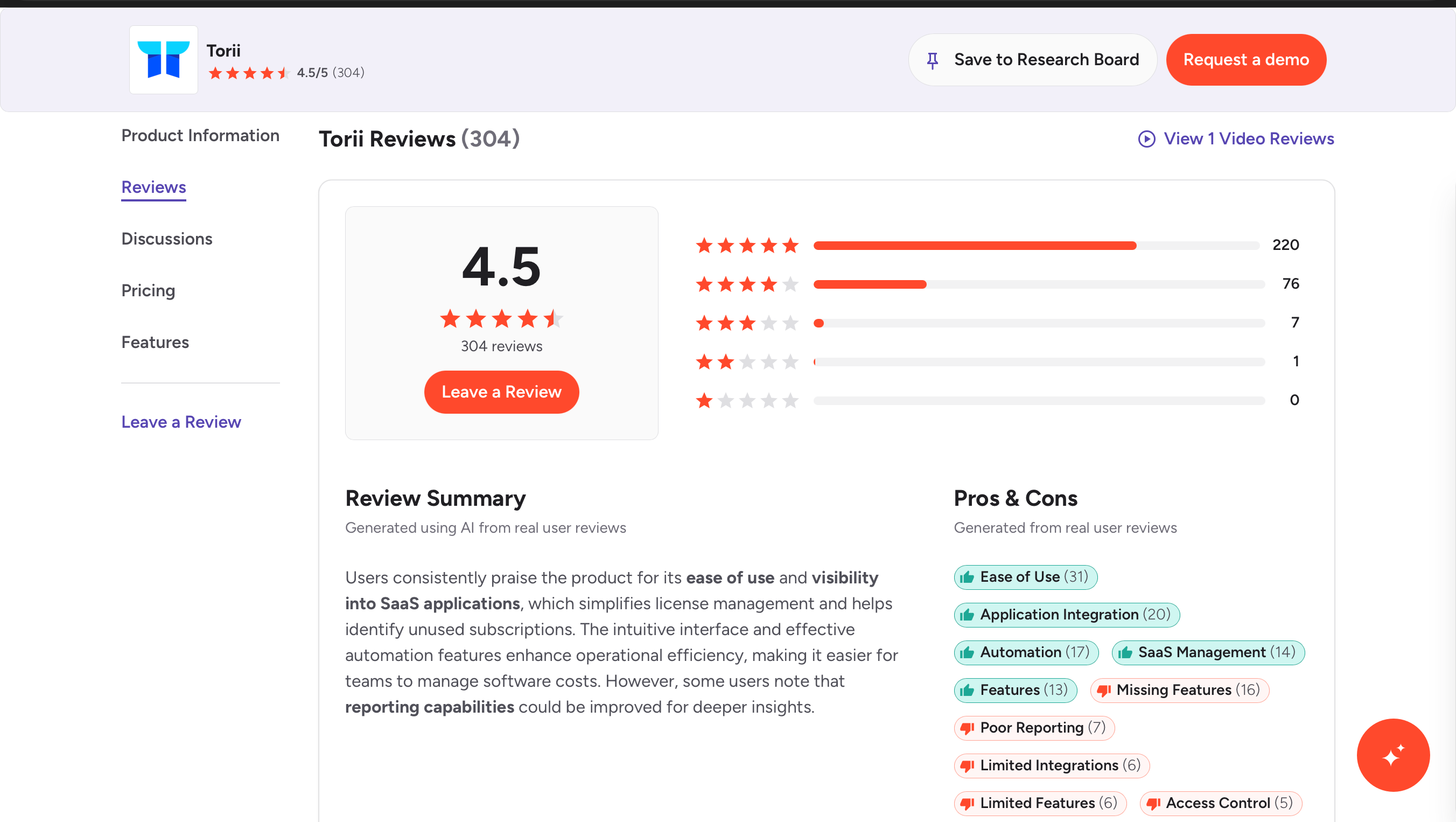
A lot of companies praise Torii for reducing operational headaches that usually consume IT teams manually.
The automation depth is consistently mentioned as one of the platform’s biggest strengths.
Teams especially appreciate how easy it becomes to:
-
reclaim unused licenses
-
monitor SaaS usage
-
automate onboarding workflows
-
simplify offboarding
-
improve access management
-
centralize SaaS visibility
Many organizations also highlight how well the platform integrates into existing operational ecosystems without creating additional friction.
Another consistent theme across reviews is how aligned Torii feels with modern operational workflows.
The platform doesn’t feel overly rigid or legacy-oriented.
Instead, it feels designed around how SaaS-heavy companies actually operate today.
Pros
-
Excellent shadow IT detection
-
Strong workflow automation
-
Great integrations ecosystem
-
Smooth onboarding/offboarding workflows
-
Clean user experience
-
Strong operational visibility
-
Helpful employee lifecycle automation
-
Modern and intuitive platform design
Cons
-
Reporting depth may not match procurement-first platforms
-
Advanced enterprise analytics can require configuration
-
Larger enterprises may need deeper customization for highly complex governance workflows
-
Procurement intelligence is not as extensive as spend-focused competitors
Summary
Torii feels like one of the smartest operational SaaS management tools currently available.
The platform stands out strongly for organizations dealing with:
-
SaaS sprawl
-
fragmented workflows
-
shadow IT growth
-
employee lifecycle complexity
-
operational inefficiencies
For companies prioritizing automation, operational efficiency, and modern SaaS governance workflows, Torii is absolutely one of the strongest platforms worth evaluating right now.
Josys vs Zylo vs Torii (Quick Comparison)
Choosing the best SaaS management platform really depends on what your organization prioritizes most.
-
Josys stands out as one of the best enterprise SaaS management platforms for modern IT operations, lifecycle automation, employee onboarding/offboarding, SaaS governance, and device management. It offers a balanced mix of usability, automation, and operational visibility.
-
Zylo is better suited for enterprises focused heavily on SaaS spend management, procurement intelligence, vendor benchmarking, and software cost optimization across large-scale SaaS ecosystems.
-
Torii excels in shadow IT discovery, SaaS automation workflows, and operational efficiency, making it a strong SaaS operations platform for fast-moving and distributed teams.
For companies looking for an all-in-one SaaS management software solution that balances governance, automation, visibility, and usability, Josys feels like one of the strongest overall choices in 2026.
How to Choose the Right SaaS Management Platform
Choosing the right SaaS management platform really depends on what operational problem your company is trying to solve first.
If your biggest challenge is controlling enterprise software spend and procurement visibility, platforms like Zylo are incredibly strong.
If your focus is automation, shadow IT detection, and employee lifecycle workflows, Torii stands out for operational efficiency.
But if you’re looking for a more modern, balanced platform that combines:
-
SaaS visibility
-
onboarding workflows
-
lifecycle management
-
compliance readiness
-
shadow IT monitoring
-
device management
-
governance automation
-
Usability
in one experience, Josys honestly feels like one of the most practical choices right now.
At Weframe Tech, one thing we realized while exploring these platforms is that usability matters far more than most enterprises expect.
Because even the most powerful SaaS management software becomes ineffective if teams avoid using it internally.
That’s why companies should evaluate platforms not just based on features, but also on:
-
ease of adoption
-
workflow simplicity
-
integration flexibility
-
onboarding experience
-
automation maturity
-
long-term operational scalability
The best platform is usually the one your teams will actually use consistently across the organization.
Conclusion
The best enterprise SaaS management platforms help organizations reduce SaaS spend, improve software visibility, automate onboarding and offboarding, strengthen governance, and optimize enterprise IT operations at scale.
SaaS management is no longer optional for large enterprises.
It has become core operational infrastructure.
As companies continue adopting AI tools, distributed workflows, and department-level software purchasing, SaaS ecosystems are becoming harder to control every year.
The best SaaS management platforms today do far more than track software.
They help companies:
-
reduce waste
-
improve visibility
-
automate operations
-
optimize renewals
-
strengthen governance
-
simplify onboarding
-
eliminate shadow IT
-
improve compliance readiness
-
secure employee access
And honestly?
We think this category is only going to become more important over the next few years.
Because software chaos scales faster than most companies expect.
Struggling to choose the right Headless CMS & Headless Commerce tech stack? We’ll help you pick the best solution for your business! Exclusive Offer: 20 Hours of Free Development & Consultation
Book a MeetingFrequently Asked Questions
A SaaS management platform helps companies track, optimize, automate, and govern the software tools used across their organization.
Large companies often manage hundreds of SaaS subscriptions across departments.
SaaS management tools help reduce waste, improve visibility, automate workflows, strengthen security governance, and improve compliance readiness.
Zylo is widely considered one of the strongest platforms for enterprise SaaS spend optimization and procurement intelligence.
Based on our research and operational analysis at Weframe Tech, Josys stands out strongly for modern IT operations, lifecycle management, identity governance, and SaaS visibility.
More than anything.
With AI tools, hybrid work, decentralized software purchasing, and growing compliance requirements, SaaS management has become critical operational infrastructure for large enterprises.